![]() |
| Examples of outlying literature |
Tuesday, 31 December 2024
Outlying, Occluded, and Thwarted Literature
Friday, 29 December 2023
'Electromania' in Strange Attractor Journal, 'Radio Obscurity' in Radio Art Zone, and other 2023 doings
Here's the obligatory end-of-year round-up / self-system-redundancy-check... Thrift, resourcefulness and low-budget solutions for soundmaking are a regular theme of this blog, but in a previous blogpost I wrote of the insoluble retrenchments demanded by a 'minus budget' - thrift's underbelly: resourcelessness. Hammering at doors hoping to find publishers and outlets has essentially become head-butting brick walls. Sponsors naturally possess biases towards commercial-viability (and, by extension, superficiality) and now, on top of this, automated algorithms contribute further to this feedback loop of asphyxia and poverty for original research. These are the ubiquitous dynamics contributing to the 'thwarted histories' that I study so gravely.
I always strive to bring new or previously obscured things into public view. Having spent a good portion of my life in bookshops, it's clear that an overwhelming amount of crowd-pleasing regurgitated hackwork is put into print by publishers who should know better (I'm bitter, of course). The ecological footprint of printed matter should be justified by the freshness of the artefact, and sadly this is seldom observed. Without any support, self-publishing is often the only option - a minefield of unforeseen expense; a tentative run of fifty copies of my textbook 'Post-Electronics: The History, Design & Philosophy of Organic Acoustic Modular Synthesisers' was glitched up by printers early this year, leaving me "looking nine ways for Sunday" as an antiquarian might put it. Just when I began to feel asphyxiated by the situation, later this year there came some blessèd aeration in the form of two very fresh, original and noteworthy volumes...
The first is the long-awaited fifth volume of the Strange Attractor Journal. It contains my well-illustrated essay 'Electromania: The Victorian Electro-Musical Experience' and, among other things, unveils the first known visual "personification" of electronic sound in 1877. Condensed across fifteen pages is a detailed account of my main object of research: Johann Baptist Schalkenbach (whose archive of German and French manuscripts I've recently had translated), his Orchestre Militaire-Electro Moteur orchestrion hybrid, and its electrifying influence on Victorian entertainment... only to be swiftly forgotten. I started researching Schalkenbach and his contemporaries fifteen years ago, and although I keep bemoaning the baffling disinterest academic employers and publishers have shown towards my analyses of it (covered also in 'Magnetic Music of the Spiritual World'), I have at least managed to give this previously unknown amalgamator of music and electricity some internet presence over those years. The Strange Attractor article adds many new elements, reproduces never-before-seen archival material, and examines the distinctions between electrical and electronic music from a Victorian standpoint.I'm reminded of an anonymous peer reviewer who green-lit my breakthrough essay on 'The Forgotten Work of J.B. Schalkenbach' in 2013's Leonardo Music Journal. They remarked "this article is the 'discovery' of a not-known precursor of electronic sound art (...) Could be a novel." Indeed, there is a resonant story behind Victorian electro-musical endeavour which has great dramatic thrust. Yet there is the recurring paradox - does obscurity beget obscurity? It does seem so, although the Strange Attractor publication is a stab towards outmanoeuvring this.
Obscurity is also the underlying theme of a text I've contributed to another book: Radio Art Zone. My text is 'On Radio Obscurity and Infinite Regress' and explores unknown/unknowable moments in radio by springboarding off the concept of a space-time radio, as discussed as early as 1928 in a rare in-house magazine for BBC engineering staff, 'Saveloy: An Aerial Magstaff'. Radio Art Zone, edited by Sarah Washington, is a spectacular full-colour hardcover containing new art, photography and texts across various paper types. Its pool of contributors includes many creators of the 22-hour radio shows engaged in Washington and Knut Aufermann's epic Radio Art Zone project. It's one of the most stimulating volumes on radio experimentation ever published, and could function as a possible "field guide" to the niche genre that is radio art (as a recent review suggested). A text by Felix Kubin particularly fired my imagination with its novel and slightly unsettling introduction of the 'radioparasite' concept (i.e. living vicariously through radio, abstracting its sonic nutrients, forgetting one's own corporeality in the process of intense listening).![]() |
| King Alfaman & Needle Boy (Knut and Lepke B) Photo by Chris Weaver |
At the event, its mastermind Sarah Washington (who also performed ultrasonic gramophonics as Batophone with Lynn Davy) alerted me to two Greek members of the audience who had travelled from afar to see me(?!) perform. They actually expected a different, more famous Dan Wilson - an acoustic guitarist - and they left slightly bemused at my post-electronic apologia. The mismatch was caused by Spotify and automated data-handling scripts linking names to incorrect performers: my name had been auto-linked to another poppier D.W. This could be seen as yet another symptom of the thwarting agencies that conduce to destroy underground culture; a vulgar automated cup-and-ball switcheroo where obscure grassroots performers are supplanted by algorithm-friendly industry-approved namesakes. On the other hand, Sarah highlighted the positive, absurdist Situationist repercussions of this, whereby bewildered pilgrims may be drawn into unexpected novel experiences. Sarah also reminded me that it seemed consistent with the uncanny serendipities that I tend to initiate unintentionally, e.g. another 'crossed wires' moment occurring during Radio Art Zone's 2022 broadcasts, where a radio aficionado - a seasoned explorer of the airwaves - happened to tune into RAZ's 87.8 FM wavelength, catching some of my 'Asphyxia' broadcast (also episodified on Resonance Extra here). Much mystery ensued until the listener at last caught the station's identity via the embedded RDS info. The listener then sent Sarah an enthused message - "I spent the rest of that night recording the station because I was certain I stumbled upon something unknown that needed to be investigated" (a message which is now featured in print on page 175 of the RAZ book). The impulse to record and investigate the unknown is the most precious of impulses.
(I'll resist pondering too much on the unknown causalities behind the odd coincidence, that is: Asphyxia had for its theme the hacking of the British Library information systems, and the suppression of information.. and recently the British Library faced the most serious cyberattack of its history, with its systems still out of action...)
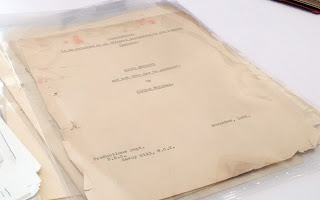
It is also worth mentioning Ed Baxter's contribution to the Radio Art Zone book - 'Rearranging the Furniture' - which traces the underlying animus behind radio through its metonymic instances. One such instance is found in the associative clunks, creaks and whirrs of radio sound-effect-making, where Baxter invokes a name I've been researching for many years: Alfred Whitman - a pioneer of radio sound effect design in the 1920s. "Alfred Whitman" was actually a stage-name of sorts, as he considered sound effect design his 'light' work. I was able to present my research on Whitman earlier this year on BBC Radio 4's 'Knock Knock: 200 Years of Sound Effects' (presented by Sarah Angliss, and produced by Michael Umney and Ed Baxter). Although my appearance in the programme is brief, Sarah Angliss and Michael Umney spent the best part of a day in the BBC's archives with me, examining a document I was first told about in 2009: Alfred Whitman's 'Sound Effects and how they may be produced' (1926).
![]() |
| Alfred Whitman's 'Sound Effects' document |
I had to think hard to recall how I learnt of this "confidential" document's existence. Its appearance on my radar came about through lengthy correspondence with an eccentric book-dealer, which highlights that the knife-edge of research is so often situated within the secondhand book trade. The document was mentioned to me by Cardiff-based bookman Alan Conchar (aka Dr. Conker) who wrote that he once had a copy, but that it had sold. Tantalising. It was unlikely another copy would surface, as I soon realised that sound effect design in the 1920s was a secretive affair, somewhat in the manner of magicians guarding their tricks, therefore any technical disclosures would've been rather against Whitman's own interests. There can't be many copies in the public domain, and indeed, libraries currently hold no copies. Enduring wonder so often persists in unobtainability's wake. By sheer serendipity, I was asked to be a part of the BBC documentary, and thanks to the efforts of Umney and Sarah Angliss' enthusiasm, a copy of Whitman's typescript was pinpointed at the BBC's archives (albeit lacking its red covers that Alan Conchar had cited). It is hoped that a re-publication of this groundbreaking manual can be arranged at some point. Whitman's sound effect work has a great bearing on modern post-electronic soundmaking: its mechanical rigours pre-figuring the control circuits of modern electronic soundmaking equipment.
Constant heartfelt thanks to all, and to readers - you - reading this rather hurried posting here.
Saturday, 22 August 2020
Oscillatorial Binnage's new post-electronic music album: 'Agitations: Post-Electronic Sounds'
![]() |
| Oscillatorial Binnage: (l to r) Chris Weaver, Fari Bradley, Dan Wilson, and Toby Clarkson. |
![]() |
| Acoustic hacking workshop, 2009. |
Miraculous agitations are instances of complex sonic progressions, usually emerging from clustered vibrating objects (see previous blogposts for more explanations). Obtaining these emergent states requires patience, but the probability of such states occurring increases with the size of the apparatus. In 2013, Oscillatorial Binnage spent a week at Maggie Thomas and Bob Drake's Borde Basse studio in the south of France, loaded up with as many salvaged/adapted objects as we could haul. Over the course of our stay, we gradually coaxed elusive 'miraculous' states to emerge from our vibrating apparatuses, not without some grind (Bob, engineering the proceedings, notably had a box of headache tablets on standby).
![]() |
| Oscillatorial Binnage recording 'Agitations: Post-Electronic Sounds' |
Bob and Maggie's array of microphones captured many moments when our apparatuses would become locked into resonating grooves. The album collects all these instances, recorded entirely acoustically without any electronic processing. These moments - technically known as 'emergence' - are one of the principal advantages post-electronic apparatuses have over electronic synthesiser-based equivalents: the possibility of unexpected sonic events arising from an infinity of real-world physical variables. Another benefit is the economical, recycling aspect: all soundmaking and filtering modules can be found for free.
We're grateful for the recent kind reviews of 'Agitations': "a panorama of hypnotic and metamorphic alterity"... "a sorely needed reminder of the miraculous in the mundane"... "bizarre titillating soundscapes" ... to quote a few. The sonic alchemy was picked up on in Julian Cowley's review in last month's The Wire magazine: "an alchemical transmutation of the routine world".
Since live performances are unlikely under the present conditions, we hope to aerate some special material over the next few months.
'Agitations: Post-Electronic Sounds' is out now on Sub Rosa.
![]() |
| The supplementary booklet with the CD of Oscillatorial Binnage's 'Agitations: Post-Electronic Sounds' |
Thursday, 30 April 2015
Fortean Times - May 2015 - Early Electronic Soundmaking (Trolling in the 1920s)
![]() |
| The BBC's anti-oscillation pamphlet |
![]() |
| Fortean Times #327 |
To coincide with the article, here I present a slice of oscillation: Song of the R33 (based on a runaway airship that allegedly had its radio communications interfered with by people oscillating their radios). The only sound sources are oscillating radio valves, and it gives a rather exaggerated flavour of the kind of sounds that polluted the airwaves of the 1920s and 30s.
![]() |
| Leon Theremin c.1927 |
So, if you want to read about this curious pre-history of the Theremin sound, check out this month's Fortean Times #327.
To end this blogpost here's a poem about oscillation from a magazine called The Ironmonger, Universal Engineer and Metal Trades' Advertiser from December 1924:
The Knob-Twiddler
This is the story of Plantagenet,
Who fiddled about with his wireless set;
He plugged in the coils and he turned all the knobs;
He twiddled about with the thingummybobs.
The one thing Plantagenet never would do,
Was to sit down and listen to gentlemen who
Were doing their best to divert and delight
This ineffably curious twiddlesome wight.
Each time he picked up a melodious air
He knew he could tune in much better elsewhere.
Reaction was tightened; then let loose again,
His aerial howls made the neighbours complain.
Whenever the set was performing its best,
Plantagenet thought he would try out a test:
And caterwauls, mingled with groans and with squeals,
Disturbed all his family and ruined his meals.
But was he depressed? Not a bit! He would sit
Picking up funny noises that learners transmit.
For hours he would sit there in rapture sublime,
With knobs and plug-in coils agog all the time:
Perhaps you have heard the unfortunate fate
Of that knob-turning fellow, Plantagenet (late).
One night he was seized by a transmission wave,
Which transported him rapidly, on past the grave,
Into the limbo where knob-twiddlers end -
The place from which night-oscillations ascend.
So all the good people who twiddle the knobs,
Who will mess about with the thingummybobs,
Whenever they hear diabolic howls -
Should remember the army of Radio Ghouls
All ready and anxious to clap down the lid
On all men who do what Plantagenet did.
Thursday, 27 November 2014
Using Radionics Radio - Sending in your Frequencies, and Avoiding 'Zero Readings'
The idea that concepts can be rendered as clusters of frequencies is an avenue of radionic thought that's still adhered to in some quarters - see The Electroherbalism Frequency Lists, for instance (based on the work of Dr. Rife). The idea resonates with homeopathic medicine which is based on infinitely subtle 'essences'. So, when a thing or a concept is intuitively linked to a set of frequencies, it is said by some that the combined waveform possesses this same 'essence' of the original concept. If you haven't tried Radionics Radio already, I urge you to have a go. If anything, it's a good crash course for radionics newcomers. However, care must be taken to avoid 'zero readings'.
Since it's launch, there have now been 100 blank submissions to Radionics Radio. These are not usable. These submissions contain the thought - but not the frequencies. Obviously, without the frequencies there is nothing Radionics Radio can practically do with the thought.
![]() |
| An example of an unusable 'zero reading' submission. Has the user missed out on $10,000? |
![]() |
| The Thought Box |
So... what happens to the thought-frequencies? Well... they are mathematically analysed for patterns, and also thought-coupling harmony experiments are taking place (more reports on this will appear soon). But basically, the thoughts are broadcast acoustically and electromagnetically: modulated over ~104.4MHz via Resonance FM, London, from the aerial on the roof of Guy's Hospital.
There have only been a limited number of broadcasts so far due to insufficient thought-frequencies to fill half-hour slots. So, please continue using the website. Early experiments indicate that when the same thought (e.g. 'compassion', 'win lotto', etc.) with different frequencies from different people are all mixed, there is possibly a strengthened manifesting effect.
Whilst on the subject of non-physical phenomena, I should also explain that Resonance FM's outbound transmission room containing the feed to the aerial is permanently acoustically irradiated with each thought in sequence. This is a room nobody generally goes in - it contains the active equipment to feed the aerial relay. See the photo below:
![]() | |
| The Radionics Radio 'secret' sonic irradiation in the inner sanctum of Resonance 104.4FM's studios. |
This unusual 'under-the-radar' 24/7 diffusion is another way to maximise any potential radionic effects. It is merely a supplement to the actual Radionics Radio broadcasts, and the live irradiation events, but this constant 'non-physical' broadcast aims to satisfy anybody more ensconced in radionic philosophy who is considering higher level use Radionics Radio (such as submitting manifestations, wishes, etc. rather than abstract concepts [which are also very welcome of course!])
More thought-frequencies submissions are needed. More data increases chances of discovering curious patterns or harmonisations. Please visit radionicsradio.co.uk and view the help video.
![]() |
| Submitted thought-frequencies are all played in sequence inside Resonance FM's transmission room. |
Saturday, 4 October 2014
Radionics Radio at the Science Gallery: Thought Diffusion Experiments
Radionics is a fringe science that, through Delawarr Laboratories, led to the first long-durational electronic sound experiments of the 20th century. Delawarr was particularly concerned with the way electronic tones interact acoustically in the air - at the first International Congress of Radionics in London, May 1950, George de la Warr demonstrated interference patterns produced by multiple loudspeakers, each respectively playing single tones that radionically related to the body (for instance, the larynx mucous membrane: 133Hz, 264Hz and 455Hz). The lively interaction of these frequencies in the air (as opposed to being mixed together into a single loudspeaker) was said to contribute to the 'acoustic therapy' process.
![]() |
| The classic Delawarr finger-stick rubber detector pad |
![]() |
| Delawarr's acoustic frequency diffusion set-up c.1947 |
Delawarr Laboratories never regarded their radionic research as music, but one of the first people to discern the correspondences between radionics and sound art was the electronic composer Daphne Oram. Oram had an interest in Delawarr's sonic experiments, but her research in this direction remains unpublished. However, there is a radionics undercurrent in her 1972 book An Individual Note of Music..., where she muses that objects and concepts possess wavepatterns that, through perception, intermodulate with our own individualised mental wavepatterns (hence the 'individual note' of the title).
"In every human being there will surely be tremendous chords of wavepatterns 'sounding out their notes'" Daphne Oram, An Individual Note of Music, Sound and Electronics, 1972.
Anybody remotely interested in electronic music and its origins will find interest in these experiments, and the Radionics Radio irradiations at the Science Gallery are quite noteworthy in that such experiments have never been trialled before on this magnitude. The audience will be privy to combinations of 'thought frequencies' harvested from the Radionics Radio web application (the latest version v2, enhanced by Jonny Stutters, offers more accuracy and wider compatibility). The irradiations will also be broadcast on Resonance 104.4FM at a later date. Delawarr applied for a radio broadcasting license in the late 1960s to similarly broadcast audio radionic tones, but were refused permission by the GPO who stated "we are unable to agree to the use of radio in the way you propose." Only now is this vision becoming reality with the help of Sound and Music.
Please visit www.radionicsradio.co.uk to convert your thoughts into frequencies.
Additional thanks to Jonny Stutters, Dr. Ed Baxter, Peter Lanceley for assistance with the diffusion experiments, and John Dignan for the generous donation of audio equipment.
Thursday, 8 August 2013
Fortean Times - Sept 2013 - Crook Frightfulness
This month's Fortean Times #305 (a sort of 'paranoia special') features my exposé of the extraordinary anonymously-penned book Crook Frightfulness, self-published in 1935 by "A Victim". In this blog post I'll present some thoughts on the book's semi-acoustical ideas.Crook Frightfulness was first brought to my attention by the marvel Westwyrd the Bard: drum-specialist and custodian of curiousness. For those unacquainted with the book, it's an autobiography of a man tormented by crooks who embark on a campaign of staring, ventriloquism and covert psychological harassments against the author. The "Victim" writes of his personal hell in which everybody else is either complicit, or simply fails to notice the ventriloquist abusers who stalk him across the British colonies. Crooks are also able to hear the Victim's thoughts by a theorised listening apparatus used with headphones (a sort of powerful stethoscope device). Some of the antiquated colonial sentiments add an extra dimension of bizarreness. A colleague described Crook Frightfulness as an "acoustic mystery thriller" although it's generally seen as a schizophrenic emission. For anybody interested in sound, its psychology and its perception/misperception, it's a particularly fascinating book, as the author manages to "attain a degree of impersonal interest" (as he puts it) and proceeds to investigate the phenomena from his own practical, acoustical viewpoint.
Crook Frightfulness is split into three parts. The first part - some 40 odd pages - begins almost like a potboiler; autobiographical sensationalism comparable to, say, Sydney Horler's 1934 exposé, London's Underworld. Part two is written more matter-of-factly, albeit disjointedly and with heightened paranoia. Here, the author writes of his experiences and travels around the colonies to outmanoeuvre the 'crooks'. The third part is the 'Vital Climax' where the crooks' terrible practices are examined (involving listening apparatuses). In FT305, it is suggested that the Victim did experience a genuine low-level persecution that left a lasting resonance.![]() |
| Charles Wheatstone's 'Telephonic Concert' at the Royal Polytechnic Institution |
"I frequently tried to stifle the annoyance by stopping or closing my ears with my fingers, and when doing so, I rested my elbows on my knees or put my elbows upon the wooden table. Strange to say, I found that neither of these expedients stopped or banished the sound (...) The sound when I stopped my ears must have travelled through the wood of the floor and of the table and then through my bones to my ears! (...) They no doubt send sounds (by means of some instrument) to molest any intended victim who is in the same premises, or even in adjoining premises."
Likewise, crooks are said to "hear your thoughts - the sound travelling through the floor you are standing on (...) to perhaps that next room or adjoining house, to the crook listener". Thoughts are heard by closely listening to sub-vocal articulation: "when you think (in 95 cases out of a hundred) you actually shape your words in your throat and mouth. When we breathe through our mouth or nose it is possible for these fiends to hear your thoughts." The Victim's theories evolve as Crook Frightfulness progresses. Some later editions feature paste-ins where a "sound 'outfit' like the BBC" is theorised. In spite of the book's skew-whiff nature, some of these ideas were certainly at the 'cutting edge' - an early example of widespread covert listening is seen in the early 1940s with the hidden electric microphones around Trent Park's prisoner-of-war compound to capture prisoners' conversations.
![]() |
| A BBC "sound 'outfit'" of the period |
The compilation of biographical facts (gleaned from both the first and expanded editions) revealed the author was born in the East End of London, in or around 1875. He was involved in rent collection and property. He left Britain for New Zealand in 1924, moved to the British West Indies around 1928, and returned to Britain to settle in Aberystwyth in March 1932. Many hours at Kew's National Archives yielded a list of some fifty or so names, gradually whittled down as each name was followed up. The use of digital archives plays a key role in such research.
It is revealed for the first time in this month's Fortean Times that Crook Frightfulness was written by an east London estate agent named Arthur Herbert Mills. He left Britain using the name Herbert Mills, and returned as Arthur Mills, which slightly confused matters, but further research has confirmed the connections. His story is very interesting, and only a bare outline could be condensed into the article.
The book presents quite a sad predicament, but it's hoped that the discovery of the author's name will enable further study of the text, which charts the onset of auditory disorientation at a point in history where technology could not quite yet provide reasonable objective explanation for the phenomena. There are a surprising number of narratives very similar to Crook Frightfulness (some early examples are examined in the article). Today, people with these afflictions/assailments often cite James Lin's 1978 textbook Microwave Auditory Effects and Applications that superficially appears to corroborate all sonic "unseen assailment" phenomena (although, in practice, such technology is very impractical).
Anyways... It's not my intention here to delve into the arguments surrounding these phenomena (perhaps in a future posting), it is simply to examine curios and mythologies from acoustical hinterlands. (It is worth mentioning that a semblance of 'voices' can be perceived during exposure to fluctuating white or pink noise for extended periods. This is a psychoacoustic effect: auditory pareidolia. In one notable example, it is employed in a sound installation by U.S. sound artist Ellen Band in her Acoustic Mirage.)The full particulars on Crook Frightfulness can be found in Fortean Times #305.
Tuesday, 16 July 2013
Bookophonics: Making Music with Books
![]() |
| Playing bookophones |
It appears that temperature affects the bookophone sound. Bookophones are generally deeply unplayable things and near-impossible to wrest a melody from, despite weeks of practice. In the summer season, books are apparently more stubborn than usual in producing tones, demanding a more vigorous action (as heard in this piece). This is perhaps because there is less discrepancy between the environmental warm temperature and the momentary heat caused by the bow friction(?). Dryness certainly deadens the tones. Anyways, it just means that in the summer, when playing the bookophone, you must really 'give it some welly'.
I can't seem to find any similar technique employed in making books 'sing', but surely over 500 years somebody must've tried something similar. Maybe a romantic poet? Incidentally, the very clever Maywa Denki laboratory has produced a musical electric book beating apparatus. (Maywa Denki received exposure in the UK some years ago with a memorable appearance of a self-playing acoustic guitar on BBC One's Adam and Joe Go Tokyo.)


