Here's the obligatory end-of-year round-up / self-system-redundancy-check... Thrift, resourcefulness and low-budget solutions for soundmaking are a regular theme of this blog, but in a previous blogpost I wrote of the insoluble retrenchments demanded by a 'minus budget' - thrift's underbelly: resourcelessness. Hammering at doors hoping to find publishers and outlets has essentially become head-butting brick walls. Sponsors naturally possess biases towards commercial-viability (and, by extension, superficiality) and now, on top of this, automated algorithms contribute further to this feedback loop of asphyxia and poverty for original research. These are the ubiquitous dynamics contributing to the 'thwarted histories' that I study so gravely.
I always strive to bring new or previously obscured things into public view. Having spent a good portion of my life in bookshops, it's clear that an overwhelming amount of crowd-pleasing regurgitated hackwork is put into print by publishers who should know better (I'm bitter, of course). The ecological footprint of printed matter should be justified by the freshness of the artefact, and sadly this is seldom observed. Without any support, self-publishing is often the only option - a minefield of unforeseen expense; a tentative run of fifty copies of my textbook 'Post-Electronics: The History, Design & Philosophy of Organic Acoustic Modular Synthesisers' was glitched up by printers early this year, leaving me "looking nine ways for Sunday" as an antiquarian might put it. Just when I began to feel asphyxiated by the situation, later this year there came some blessèd aeration in the form of two very fresh, original and noteworthy volumes...
The first is the long-awaited fifth volume of the
Strange Attractor Journal. It contains my well-illustrated essay 'Electromania: The Victorian Electro-Musical Experience' and, among other things, unveils the first known visual "personification" of electronic sound in 1877. Condensed across fifteen pages is a detailed account of my main object of research: Johann Baptist Schalkenbach (whose archive of German and French manuscripts I've recently had translated), his Orchestre Militaire-Electro Moteur orchestrion hybrid, and its electrifying influence on Victorian entertainment... only to be swiftly forgotten. I started researching Schalkenbach and his contemporaries fifteen years ago, and although I keep bemoaning the baffling disinterest academic employers and publishers have shown towards my analyses of it (covered also in '
Magnetic Music of the Spiritual World'), I have at least managed to give this previously unknown amalgamator of music and electricity some internet presence over those years. The
Strange Attractor article adds many new elements, reproduces never-before-seen archival material, and examines the distinctions between electrical and electronic music from a Victorian standpoint.
I'm reminded of an anonymous peer reviewer who green-lit my breakthrough essay on 'The Forgotten Work of J.B. Schalkenbach' in 2013's Leonardo Music Journal. They remarked "this article is the 'discovery' of a not-known precursor of electronic sound art (...) Could be a novel." Indeed, there is a resonant story behind Victorian electro-musical endeavour which has great dramatic thrust. Yet there is the recurring paradox - does obscurity beget obscurity? It does seem so, although the Strange Attractor publication is a stab towards outmanoeuvring this.
Obscurity is also the underlying theme of a text I've contributed to another book:
Radio Art Zone. My text is 'On Radio Obscurity and Infinite Regress' and explores unknown/unknowable moments in radio by springboarding off the concept of a space-time radio, as discussed as early as 1928 in a rare in-house magazine for BBC engineering staff, '
Saveloy: An Aerial Magstaff'.
Radio Art Zone, edited by Sarah Washington, is a spectacular full-colour hardcover containing new art, photography and texts across various paper types. Its pool of contributors includes many creators of the 22-hour radio shows engaged in Washington and Knut Aufermann's epic
Radio Art Zone project. It's one of the most stimulating volumes on radio experimentation ever published, and could function as a possible "field guide" to the niche genre that is radio art (as a
recent review suggested). A text by Felix Kubin particularly fired my imagination with its novel and slightly unsettling introduction of the 'radioparasite' concept (i.e. living vicariously through radio, abstracting its sonic nutrients, forgetting one's own corporeality in the process of intense listening).
 |
King Alfaman & Needle Boy (Knut and Lepke B)
Photo by Chris Weaver |
RAZ's book launch took place last month (November 4th - also streamed on
Resonance Extra) at
IKLECTIK (a hugely important but now-imperilled venue), where the project's hallmark of extreme duration was upended: performers were asked to perform for a snappier ten minutes. I performed an exposition on the technique and philosophy of miraculous agitations, coaxing sonic miracles from my electromagnetic apparatuses (which, in keeping with the radio theme, happen to radiate very-short-range actuative EM waves). The short slot wasn't long enough to demonstrate such marvels (miracles take time), but unexpected rhythms and proto-miraculous shudderings emerged, along with shrieks for employment in any paid capacity whatsoever.
At the event, its mastermind Sarah Washington (who also performed ultrasonic gramophonics as Batophone with Lynn Davy) alerted me to two Greek members of the audience who had travelled from afar to see me(?!) perform. They actually expected a different, more famous Dan Wilson - an acoustic guitarist - and they left slightly bemused at my post-electronic apologia. The mismatch was caused by Spotify and automated data-handling scripts linking names to incorrect performers: my name had been auto-linked to another poppier D.W. This could be seen as yet another symptom of the thwarting agencies that conduce to destroy underground culture; a vulgar automated cup-and-ball switcheroo where obscure grassroots performers are supplanted by algorithm-friendly industry-approved namesakes. On the other hand, Sarah highlighted the positive, absurdist Situationist repercussions of this, whereby bewildered pilgrims may be drawn into unexpected novel experiences. Sarah also reminded me that it seemed consistent with the uncanny serendipities that I tend to initiate unintentionally, e.g. another 'crossed wires' moment occurring during Radio Art Zone's 2022 broadcasts, where a radio aficionado - a seasoned explorer of the airwaves - happened to tune into RAZ's 87.8 FM wavelength, catching some of my 'Asphyxia' broadcast (also episodified on Resonance Extra here). Much mystery ensued until the listener at last caught the station's identity via the embedded RDS info. The listener then sent Sarah an enthused message - "I spent the rest of that night recording the station because I was certain I stumbled upon something unknown that needed to be investigated" (a message which is now featured in print on page 175 of the RAZ book). The impulse to record and investigate the unknown is the most precious of impulses.
(I'll resist pondering too much on the unknown causalities behind the odd coincidence, that is: Asphyxia had for its theme the hacking of the British Library information systems, and the suppression of information.. and recently the British Library faced the most serious cyberattack of its history, with its systems still out of action...)
It is also worth mentioning Ed Baxter's contribution to the Radio Art Zone book - 'Rearranging the Furniture' - which traces the underlying animus behind radio through its metonymic instances. One such instance is found in the associative clunks, creaks and whirrs of radio sound-effect-making, where Baxter invokes a name I've been researching for many years: Alfred Whitman - a pioneer of radio sound effect design in the 1920s. "Alfred Whitman" was actually a stage-name of sorts, as he considered sound effect design his 'light' work. I was able to present my research on Whitman earlier this year on BBC Radio 4's 'Knock Knock: 200 Years of Sound Effects' (presented by Sarah Angliss, and produced by Michael Umney and Ed Baxter). Although my appearance in the programme is brief, Sarah Angliss and Michael Umney spent the best part of a day in the BBC's archives with me, examining a document I was first told about in 2009: Alfred Whitman's 'Sound Effects and how they may be produced' (1926).
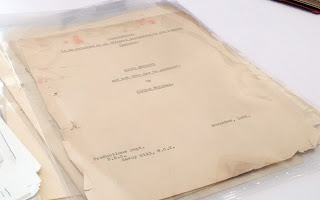 |
| Alfred Whitman's 'Sound Effects' document |
I had to think hard to recall how I learnt of this "confidential" document's existence. Its appearance on my radar came about through lengthy correspondence with an eccentric book-dealer, which highlights that the knife-edge of research is so often situated within the secondhand book trade. The document was mentioned to me by Cardiff-based bookman Alan Conchar (aka Dr. Conker) who wrote that he once had a copy, but that it had sold. Tantalising. It was unlikely another copy would surface, as I soon realised that sound effect design in the 1920s was a secretive affair, somewhat in the manner of magicians guarding their tricks, therefore any technical disclosures would've been rather against Whitman's own interests. There can't be many copies in the public domain, and indeed, libraries currently hold no copies. Enduring wonder so often persists in unobtainability's wake. By sheer serendipity, I was asked to be a part of the BBC documentary, and thanks to the efforts of Umney and Sarah Angliss' enthusiasm, a copy of Whitman's typescript was pinpointed at the BBC's archives (albeit lacking its red covers that Alan Conchar had cited). It is hoped that a re-publication of this groundbreaking manual can be arranged at some point. Whitman's sound effect work has a great bearing on modern post-electronic soundmaking: its mechanical rigours pre-figuring the control circuits of modern electronic soundmaking equipment.
Constant heartfelt thanks to all, and to readers - you - reading this rather hurried posting here.


