Showing posts with label daphne oram. Show all posts

Wednesday, 10 May 2023

'Asphyxia: The "Idiote", the Library Wifi and the Suppressed Safe'

At 6pm today (Wednesday 10th May) Resonance Extra will begin a regular episodic version of what was originally a single 22-hour radio show commissioned by Radio Art Zone: 'Asphyxia: The "Idiote", the Library Wifi and the Suppressed Safe'.

Late in 2022 I was commissioned by Radio Art Zone to be a part of their epic 100-day radio art project.  Radio Art Zone was conceived by Sarah Washington and Knut Aufermann as a radio station - without any interrupting adverts - relaying massive radio shows internationally, and streaming online.  The length of each 22-hour contribution meant that listeners were plunged deep into sound-worlds, grasping at whatever radiophonic cues were at hand to ascertain contexts, acoustical conditions, geographical locations, themes, or narrative arcs (if any).

I titled my show 'Asphyxia' in anticipation of the suffocating atmosphere that'd likely pervade when smothered by a single person's 22-hours.  Many other Radio Art Zone participants minimised the threat of asphyxia by infusing the oxygen of the outside world - e.g. Chris Weaver (fellow Oscillatorial Binnage member) produced 'Rushy Green Tape Exchange' - 22 hours of cassette diary exchanges with improv artist Adam Bohman, spanning continents in their scope; or more explicitly 'Body Edit Mind' by Milo Thesiger-Meacham saw a vast amount of obscure media found online interspersed with real-life recordings testing the limits of editability.

I confess to not having heard many of the other 22-hour shows in full, and I doubt any listener absorbed my contribution beyond a mere dip.  The new Resonance Extra broadcasts of 'Asphyxia: The "Idiote", the Library Wifi and the Suppressed Safe', commencing today, offer more manageable regular one-hour timeslots.

More properly, 'Asphyxia' refers to the all-too-familiar dynamics that condemn things to obscurity. (Incidentally, I have supplied a text on this theme for an upcoming book published by Radio Art Zone's Sarah and Knut, release date TBC).

The show is described as "a damaged would-be radio documentary exploring the Narnia of restricted access material with its wedded themes of suspicion, gatekeeping, conspiracy, frustration, and the maddening infinite regress that emerges wherever information is suppressed.  It is a journey into the inner turmoil of being forestalled; namely, a condition electronic composer Daphne Oram termed 'mismatched impedance'; - where vocation is thwarted, heralding the onset of emotional disturbance as one's energies are clipped and distorted."

The "Library Wifi" refers to the 'hackable' streams of data passing through The British Library's network, whilst the "Suppressed Safe" is the British Library's restricted access material.  Overshadowing all this is my controversial "work where you like" practice whereby I trespass into workplaces where I've been denied employment to "volunteer" my services to prove my employability. The "Idiote" signifies the person in the street, as opposed to the "Clubman" - the patriarch in-the-know; two terms crystallised in the Edwardian era by paranoid ex-accountant turned amateur etymologist, Marcus Stanley Chambers (aka "Exact Thinker"), who wrote scathingly of uncooperative national institutions withholding (supposedly) secret knowledge on the origin of language.

Marcus S. Chambers' illustration

There is an undercurrent of thwarted research and wasted energies throughout the series. Abused necks - seats of human voice - are given special attention in today's first episode - anatomical points of interest in the work of Marcus S. Chambers, and his anarchist, masonic-secret-exposing counterpart Sydney Hanson (with his DIY printing press). These authors are part of an ongoing research project I'd started as long ago as 2006, but ironically I found no willing outlets to publish anything, leading me to wonder half-heartedly whether there really was a conspiracy of silence around their findings. The present-day obscurity of their work forms a self-fulfilling prophecy about the suppression of knowledge (and opportunity), lending much unease, mystery, and squirms to outmanoeuvre "crank" vibes throughout the show.

If the aforementioned makes any sense at all, it should shed light on the many hindrances and impoverishments that have curtailed my activities of late (and others too, I note - the cost of living is crippling), hence lack of posts here lately.  Yet this in itself is interesting, and it's worthwhile to make a study of the factors at play, identifying solutions, etc., continuing the ongoing theme of 'thwarted histories' on this blog and elsewhere.

Saturday, 4 October 2014

Radionics Radio at the Science Gallery: Thought Diffusion Experiments

This coming Tuesday - 7th October - there will take place a diffusion of 'thought frequencies' at the Science Gallery Pop-Up in Boland House, London Bridge.  It forms part of the Radionics Radio project, which is an extension of the groundbreaking acoustic radionic experiments conducted by George and Marjorie de la Warr at their Delawarr Laboratories beginning in the late 1940s.

Radionics is a fringe science that, through Delawarr Laboratories, led to the first long-durational electronic sound experiments of the 20th century.  Delawarr was particularly concerned with the way electronic tones interact acoustically in the air - at the first International Congress of Radionics in London, May 1950, George de la Warr demonstrated interference patterns produced by multiple loudspeakers, each respectively playing single tones that radionically related to the body (for instance, the larynx mucous membrane: 133Hz, 264Hz and 455Hz).  The lively interaction of these frequencies in the air (as opposed to being mixed together into a single loudspeaker) was said to contribute to the 'acoustic therapy' process.

The classic Delawarr finger-stick rubber detector pad
Delawarr's acoustic frequency diffusion set-up c.1947
The clusters of frequencies were originally identified by concentrating on a thought whilst turning an electronic oscillator and rubbing a 'detector pad'.   Whenever the finger encountered a 'stick' - or some friction - on the pad, the frequency was noted down.  In this way, frequency combinations relating to thoughts were obtained.

Delawarr Laboratories never regarded their radionic research as music, but one of the first people to discern the correspondences between radionics and sound art was the electronic composer Daphne Oram.  Oram had an interest in Delawarr's sonic experiments, but her research in this direction remains unpublished.  However, there is a radionics undercurrent in her 1972 book An Individual Note of Music..., where she muses that objects and concepts possess wavepatterns that, through perception, intermodulate with our own individualised mental wavepatterns (hence the 'individual note' of the title).

"In every human being there will surely be tremendous chords of wavepatterns 'sounding out their notes'"  Daphne Oram, An Individual Note of Music, Sound and Electronics, 1972.

Anybody remotely interested in electronic music and its origins will find interest in these experiments, and the Radionics Radio irradiations at the Science Gallery are quite noteworthy in that such experiments have never been trialled before on this magnitude.   The audience will be privy to combinations of 'thought frequencies' harvested from the Radionics Radio web application (the latest version v2, enhanced by Jonny Stutters, offers more accuracy and wider compatibility).  The irradiations will also be broadcast on Resonance 104.4FM at a later date.  Delawarr applied for a radio broadcasting license in the late 1960s to similarly broadcast audio radionic tones, but were refused permission by the GPO who stated "we are unable to agree to the use of radio in the way you propose."  Only now is this vision becoming reality with the help of Sound and Music.

Please visit www.radionicsradio.co.uk to convert your thoughts into frequencies.

Additional thanks to Jonny Stutters, Dr. Ed Baxter, Peter Lanceley for assistance with the diffusion experiments, and John Dignan for the generous donation of audio equipment.

Sunday, 25 September 2011

The Voynich Manuscript - An Acoustic Interpretation

The baffling Voynich Manuscript, written in an apparently indecipherable script, has caused much head-scratching since its rediscovery in 1912.  Thought to be of mediaeval origin, it contains quasi-astrological diagrams, depictions of strange devices, plants - unlike any earthly flora - alongside nude figures bathing in complex networks of 'pools' featuring recycled water (some mechanisms of which look decidedly unhygienic to modern eyes).  Some reckon it to be an alchemical text, whilst others believe it a hoax or an artistic exercise in glyptolalia.  Judge for yourself here.

One intriguing set of theories proposed by H. Richard SantaColoma speculate upon its possible representation of Sir Francis Bacon's New Atlantis, specifically Solomon's House - its college.  For this, it must be assumed that the manuscript was written in the early 17th century (or slightly earlier depending on the actual conception of the New Atlantis utopia) albeit on 15th century vellum (as carbon dating has proven).  The optical activities of the 'Perspective Houses' along with the grafting of diverse plants are considered as being represented within the manuscript.  However, if this theory is true, where are Solomon's House's famed 'Sound houses'?  Could the 'sound' chapter have once comprised the now missing excised 32 pages?

Sonic activities in Solomon's House, New Atlantis

These theories are inspiring to contemplate.  There are so many conflicting ideas vying for consideration surrounding the Voynich manuscript that it wouldn't do much harm to throw in my tuppence worth, as far fetched as my following speculation may *sound*...

It seems that nobody has yet considered the Voynich Manuscript entirely in terms of acoustics.  Does the whole manuscript in fact concern sonics?  Admittedly, at first glance it would appear that sound or music is entirely absent, but to those acquainted with cymatics a possible avenue of investigation reveals itself.  (This may be a cue for some people to stop reading any further, especially for those who stand by the old adage "all comparisons are odious").  In the tradition of Daphne Oram's bravura sonic speculations, tentative explorations can be made with this acoustic angle.


In the 1880s, the singer Margaret Watts Hughes developed a technique of producing 2D organic forms on a flexible membrane strewn with a fine powder, a la Chladni's plate (but with the singing voice as the agitator).  The membrane was stretched over a sounding chamber with a pipe connected to it, through which Hughes would sustain tones, varying in timbre.  Upon the membrane, plant-like and fern-like forms were made by steadily moving the eidophone membrane over paste-covered glass, in effect creating a recording.  This technique produced entire gardens of sorts.  In 1891, Hughes wrote "(…) day by day I have gone on singing into shape these peculiar forms, and, stepping out of doors, have seen their parallels living in the flowers, ferns and trees around me; and, again, as I have watched the little heaps in the formation of the floral figures gather themselves up and then shoot out their petals, just as a flower springs from the swollen bud".  Could the Voynich manuscript depict eidophonic activities?

A Voynich 'rosette'
In the 20th century, Hans Jenny coined the term 'cymatics' to refer to the basic visible-sound phenomena.  Jenny used piezo-electric agitation, and also employed water-filled plates (although producing forms in liquids with only the voice would be very difficult - requiring acute volume and pinpoint pitch).  However, many of Jenny's most iconic cymatic figures were produced by electronic oscillators operating in the kilohertz domain - above vocal range.

Eidophones
Throughout the Voynich manuscript, 'sprays' and 'streams' can be seen issuing from bizarre pipes.  The wavy streams are evidently liquids of some sort, although the sprays are more incongruous.  The technique of producing fine sprays from liquids was proposed by Bernoulli in his 1738 book 'Hydrodynamica' and was only perfected in the form of atomisers in the mid 19th century.  Some of these spray emissions in the manuscript seem to defy gravity, ruling out powder sprays.  Are these sprays early representations of sound?  It's worth mentioning that the now-discredited corpuscular theory of sound was 'in the air' since the 1620s.


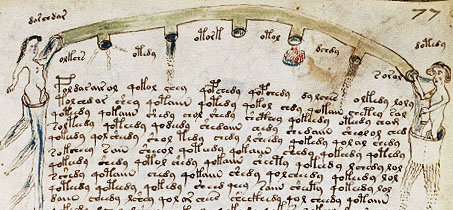
On page 77 of the manuscript, five 'elements' are illustrated issuing from a pipe manned by figures at each end.  The figure on the right has an apparent emission towards or from the mouth.  Does it represent the formative powers of sound?  There are other suggestions of this power, such as in the 'rosettes' fold-out where buildings are seen emerging from the primordial patterns.  Also, the majority of the figures shown throughout have their mouths in an 'O' shape hinting at voice production.  The images of 'bathers in pools' may actually depict naked choirs all sounding the same resonant note, crowded inside large resonant drums and cavities sending their voices through tubes to membranes, upon which large voice figures figures may be produced.  Their nudity might be due to the fact that clothing absorbs sound, whereas skin (especially if wet) is more reflective of sound (performers today note that acoustics of rooms alter when an audience is present) thus preserving resonance.

The manuscript's astrological charts show some similarities to cymatic figures.  The charts showing improbable spiral forms may indicate motion, as the combined voices of the singers would be rife with rich phasings (chorusing) which would translate as an unstable, moving cymatic figure, with manifest rotary motions.  The symbolic demarcations of some charts might be attempts at macro/microcosmic integration by corresponding the limbs of voice figures with astrological houses.


The chorusing, that is, the cumulation of pitch and tone discrepancies in a choir voicing the same note, would create 'blurred' unstable voice figures.  Maybe the vase-like devices shown in the final section of the manuscript are Helmholtz resonators, or Vitruvius' urns, tuned to enhance/amplify the purity of the tone?  Furthermore, were membranes stretched over the mouth of these ornate resonator urns?  (H. Richard SantaColoma suggests these devices shown were not resonator urns, but early microscopes).

If an eidophonic system is depicted, the manuscript's exotic plant forms may derive from species of cymatic/eidophone voice figures.  But this begs the question as to why the plants are coloured - as any particle-based eidophone figures would certainly not be colour specific.  Of course this is all an extremely tenuous speculation.  All natural forms have harmonic characteristics (most notable in phyllotactic patterns) and are thus potentially translatable into sound.  Besides, there's scant historical record of any such vibratory practices occurring in antiquity, and certainly none this elaborate.  However, it may be remembered that study of natural phenomena was strictly forbidden for centuries in Christendom, and beyond.

Resonators?
The likeliest theory is that the Voynich manuscript is a fantastical piece of systematised confusion: a dreamscape of pure flummox, maybe of hallucinatory origin.  The style was even expertly pastiched by Luigi Serafini in his 1981 masterpiece 'Codex Seraphinianus' - a monumental oddity of glyptolalia.  Imagine randomly finding a book so utterly odd it can only be assumed to originate from another planet.  Incidentally, this is surely the touchstone of mediadropping!

As a footnote, the woodcut a few paragraphs above showing a New Atlantis 'Sound House' appears quite a lot online, and is often said to originate from an old imprint of New Atlantis.  It may go some way to show how easily we may be deceived by forgings of period styles, as, after some research, it transpired that it's in fact a pastiche of 17th century engraving created by 20th century U.S. artist Lowell Hess.  It's from a 1970 book titled 'Graphic Design for the Computer Age'.

UPDATE 22/10/11: H. Richard SantaColoma has pointed out that the 'rosettes' fold-out page of the Voynich Manuscript most likely depicts a map, perhaps detailing the various departments of the House of Solomon.  Here, a candidate for the Sound House is identified in the top left hand corner.  He draws attention to the pointed loudhaileresque tubes, seen both as an extended pentad on the Sound House, and in shorter clusters surrounding the central House of Solomon.  It can be seen here.

Thursday, 14 July 2011

The Wire - August 2011 - Daphne Oram

To mark the exhibition of the Oramics machine at The Science Museum, this month's The Wire contains an article I wrote on the little-known esoteric interests of Daphne Oram.  This represents, it seems, the most extensive examination of this aspect of Oram's work in print at present.  Daphne Oram was a true pioneer in experimental and electronic music - she is known principally for her establishing of the BBC Radiophonic Workshop and her subsequent development of Oramics (a technique of crafting electronic music by hand-drawn notation).


What is not generally known is that Oramics refers not solely to the drawn sound technique, but also to a wider philosophy of sound - a holistic approach to studying all vibrational phenomena and their relationship to human life.  Part of the reason for the obscurity of this phase of Oramics may be in part due to the general scarcity of the only book she published - her groundbreaking 'An Individual Note of Music, Sound and Electronics' (1972).


'An Individual Note ...' presents not only a breathtakingly fresh perspective on electronic music, but also asks "fascinating questions relating to the working of the human mind and the present and future roles for the individual and for society".  It studies the human aspects of electronic music.  Of particular relevance today is the analogy Oram gives involving "mismatched impedance" (relating to audio devices improperly connected).  For a healthful functioning society, people must find matched impedances, e.g. university graduates should secure an employment where their energies are put to use comfortably.  If a highly qualified or energetic individual finds himself/herself psychologically constrained, working in a fish and chip shop, a form of potentially damaging distortion ensues.  I would personally go further and say that if no matched impedance is provided, i.e. unemployment upon graduation, it is utterly destructive in many ways - one's activity is bounded by hard constraints (waveform clipping!) and these ricochets against the constraints produce agonising harmonics.  Incidentally, the writer known for studies into the unknown, Colin Wilson, has highlighted a link between artistic frustration and criminality... But I digress...

In the early 1980s Daphne was preparing another book, this time on ancient acoustics - a field of study known today as archaeoacoustics (the most notable recent study being 'Archaeoacoustics' published by McDonald Institute in 2006).  If her manuscript, 'The Sound of the Past', had been expanded and published in book form, it would have marked yet another pioneering achievement.  Sadly, lack of matched impedances prevented this being realised.  However, this short unfinished text will soon be available on the Daphne Oram website.

In 'An Individual Note', Oram places emphasis on the joy of musing - "on sniffing the air" and "catching scents".  She says, "if the scents lead me sometimes 'up the garden path', I still enormously enjoy catching them".  In time, science may go some way to verify some of Oram's more radical speculations (particularly those in her unpublished notes).  For instance, the behaviour of the human organism in response to geomagnetic wave phenomena is taken more seriously now than in previous decades.  These zones of thought on the periphery between knowledge and mystery are also where profoundly fascinating insights take place, with accompanying inspirations.  And such inspiration is, after all, fine fuel for artistic creative endeavours.

Acupuncture, astrology, ancient resonances of Egypt's Great Pyramid and Britain's dolmens and barrows, John Erskine Malcolm's curious theory of systemic arterial resonance.... Read about all this (and more) in this month's The Wire, issue 330... because it's extremely difficult to condense all this into a single blog post.