Showing posts with label acoustic synthesis. Show all posts

Friday, 4 September 2020

Parallel Worlds - Pre- and Post-Electronic Music Technology in Electronic Sound #68

Electronic Sound issue 68
To coincide with the release of Oscillatorial Binnage's album 'Agitations: Post-Electronic Sounds', this month's Electronic Sound magazine (with Devo on the cover) contains my six-page article on pre-electronic soundmaking and its technological parallels with post-electronic music.  This blogpost provides some further perspectives.  A common thread linking pre- and post-electronic approaches is the acoustic manipulation of musical tone and rhythm, necessarily through physical mechanisms.  The study of pre-electronic music reveals parallel histories in electronic music... 'Parallel Worlds' is the title of the Electronic Sound feature.

J. B. Schalkenbach's Piano Orchestre Electro Moteur
It's rather historic to see neglected innovations of the past that I've long been excavating at last being assimilated into such a mainstream electronic music publication as Electronic Sound magazine: the electronic feedback instrument of Alfred Graham (which has no presence in electronic music history whatsoever, beyond my own publications), and Johann Baptist Schalkenbach's Orchestre Militaire Electro-Moteur are touched upon in the article (Schalkenbach's instrument gets a whole page to itself!).  The stories behind both are more thoroughly documented in my book 'Magnetic Music of the Spiritual World', for which I'm *still* seeking a proper publisher in the wake of my tiny self-published edition of 2015.  This project is, in fact, now expanded to encompass further examples of what I call 'failed histories' beyond the pre-electronic era... There's an enduring irony that failed histories seem to beget failure, inasmuch as they seem impervious to wider publisher interest - my project deemed by one outlet as "too eccentric".

Many of these hitherto undocumented histories were discovered through my activities on the fringes of the antiquarian book world.  Ephemera and self-published material is of particular interest - items seldom found catalogued anywhere else.  Such items represent lone voices calling out from the abyss.  At a second-hand bookshop, I once found a volume of acoustical patents, each with their original blue wrappers, and replete with fold-out diagrams, all bound into a hardcover for some unknown private library or collector some hundred years ago.  One particular patent in this book sheds some light on the 'failed history' dynamic...

In 1879, a patent was deposited by one Eugene Ernest Bornand for a rudimentary "musical instrument" called 'Le Vibrateur'.  This pre-electronic sound-effects device is briefly mentioned in the Electronic Sound article, as well as the Oscillatorial Binnage 'Agitations' CD booklet.  Le Vibrateur was designed by Bornand to alter the sound of a voice or a musical instrument.  The passage of sound through a flexible tube would cause two convex plates attached at the end to vibrate.

Eugene Ernest Bornand's 'Le Vibrateur'

Le Vibrateur was similar to the classic Punch and Judy 'swazzle' in that it distorted sound.  The obvious difference was that the swazzle - a reeded diaphragm - was inserted directly into the roof of the performer's mouth to create the buzzy voice, whilst Bornand's instrument had a tube enabling more varied uses.  The swazzle was considered a trade secret to Punch and Judy performers, yet boasted an international presence as widespread as the Punch tradition itself: in France the swazzle is called the sifflet–pratique, and in Italy the pivetta, etc.  It would've been considered perverse (in Punch and Judy circles) for some monopolist to attempt to patent the swazzle.  Despite the aforementioned differences, Bornand's Vibrateur is eyebrow-raisingly close to the swazzle, but Bornand widened the commercial scope of his innovation, encouraging a more practical use for it in fog signalling.  Bornand also saw the Vibrateur's potential in recreating orchestral sounds: "by varying the size, shape, and material used, I can produce imitations of every musical instrument, so that I can create the same effect as a full orchestra".  With post-electronic sound in mind, an aspect of interest for modern ears was Bornand's suggestion of new sonic possibilities - the Vibrateur player could adjust the buzz of the plates by pressing them together "causing the evolution of modified sound, weird, grotesque, or euphonious".

Little is known about the Vibrateur's patentee: a mysterious figure who declared his profession as "artist lyrique".  The term artiste lyrique was unusual in Victorian Britain, but was sometimes deployed as a pretence to elevate the art of the 'characteristic vocalist' into Frenchified bohemian realms (although it was generally reserved for female vocalists).  No trace of Eugene Ernest Bornand can be found in censuses, and his (or her, or their) patent appears to be communicated to the Patent Office directly, rather than through an international agent, making it likely the inventor was based in the UK.  There's a genealogical record of a Swiss national named Eugene Bornand arriving in Britain in August 1851, but there the trail goes cold.  It's possible that there was no such person as Eugene Ernest Bornand - it may be a pseudonym.  British performers often adopted more exotic-sounding names, and it wasn't unknown for patentees, especially music hall performers, to use nom-de-plumes, but there's no record of Eugene Bornand on the entertainment circuit either.

As part of the legal process, Bornand's patent had a witness signatory, a London-based "Wm. H. Le Troir" of 26 Budge Row.  This *was* a pseudonym (or could it be the printer's failed attempt to decipher an illegible signature?) - this was actually William Henry Le Fevre, a patent agent, engineer and president of The Balloon Society of Great Britain.

In the Vibrateur patent, Eugene Ernest Bornand gives his own address as "8 Howland Street" in Fitzrovia, London; a residential street in London's West End - a suitable dwelling for an artiste lyrique, in the entertainment district.  Howland Street was an interesting neighbourhood at this time...  At 7 Howland Street lived Adam Weiler, an activist cabinet-maker and friend of Karl Marx.  Meanwhile, 9 Howland Street hosted Swiss artist Frank Feller, lodging with older German painter Anthony Rosenbaum (painter of 'Chess Players', held by the National Portrait Gallery).  At 6 Howland Street lived the Pitman family who were all musicians going back for many generations, with the youngest daughter, 22-year-old Elizabeth Catherine Pitman being a teacher, and later, professor of music.  But who lived at 8 Howland Street?

Beyond what's stated in the Vibrateur patent, there's no record of a Eugene Bornand living at 8 Howland Street.  The 1881 census, however, does show one likely individual boarding there: a 22-year-old "vocalist" named Tom Ross.  Could this be the artiste lyrique, Eugene Bornand?  Stated as being born in Cheshire, Tom Ross is similarly elusive, with no further positive matches found in any genealogical databases.  Two of Tom Ross' fellow 8 Howland Street lodgers are in the same age bracket and likewise have theatrical professions - Charles Scott, also 22, was a "characteristic dancer" from Sheffield, and a John Preston: a 19-year-old "dress designer / milliner" from Devon.  These fellow travellers are also difficult to trace definitively.

Eugene Bornand's identity cannot yet be proven, but his sole patent, Le Vibrateur, is a significant example of a forgotten invention, overlooked or deemed unprofitable at the time, that may now be reappraised - in a manner only possible after the advent of electronic sound - through the lens of modernity, as a proto-effects-unit; an attempt to mechanically engage with musical tone, and a useful component for any post-electronic apparatus (indeed, Oscillatorial Binnage use similar methods on 'Agitations').

Whether or not Eugene Bornand was Tom Ross is a moot point.  The obliteration of both these identities from historical records illustrates the 'failed history' dynamic.  In the entertainment world, there's a tendency to pile pseudonym upon pseudonym, and when you factor in the constantly shifting whereabouts of a travelling performer, it makes cobbling together a biography of such an individual via official documents near-impossible.  Poverty was also a key factor: in a cautionary exposé of the perils of performer life, the 1885 edition of 'The Truth about the Stage' by the pseudonymous 'Corin'* warns prospective entertainers against "the meretricious glare of life behind the curtain," and its "halo of romance, which is rarely dispelled until the fatal step is taken and when it is too late to turn back".  (And maybe there's a lesson here for modern electronic and experimental performers... as I sense increasingly sharply through experience.)

* (Bizarrely, Corin - the author of 'The Truth about the Stage' (1885) was apparently the pseudonym of William Lynd, the great-grandfather of writer and The Wire contributor Clive Bell.)

Oscillatorial Binnage's 'Agitations: Post-Electronic Sounds' is out now on Sub Rosa records.  Read more in this month's Electronic Sound #68.

Saturday, 22 August 2020

Oscillatorial Binnage's new post-electronic music album: 'Agitations: Post-Electronic Sounds'

Finally.  After countless struggles finding an outlet for this uncategorisable work, Oscillatorial Binnage's long-delayed album is out at last: 'Agitations: Post-Electronic Sounds'.  It's on the Brussels-based Sub Rosa label - physical CD copies are accompanied by a colour illustrated booklet, 'A Primer on Post-Electronic Technique'.  The album is entirely post-electronic, arbitrarily microtonal music created using mechanical assemblies of found objects, resonated with electromagnetic force fields.  Distribution has been slowed by the pandemic, but it's available on Bandcamp (and also directly from me via the main Miraculous Agitations site).  Mirroring the current situation, the album envisions an apocalyptic paradigm shift scenario, necessitating adaptation in the face of adverse conditions (in this case, an imagined post-electronic situation: how might musicians create exploratory electronic music, with its emphasis on waveshaping, filters and modulation processes, without any synthesisers?  This album provides the answer).

Oscillatorial Binnage: (l to r) Chris Weaver, Fari Bradley, Dan Wilson, and Toby Clarkson.

Acoustic hacking workshop, 2009.
Oscillatorial Binnage is Fari Bradley, Chris Weaver, Toby Clarkson, and myself.  We've been performing together for fifteen years, during which time we've introduced many unusual new electroacoustic instruments, along with the concept of acoustic hacking.  'Agitations' features the electromagnetic resonators that I've been developing since 2004.  We've given many workshops around the world, teaching participants how to access the hidden frequencies of scrap objects using coils and force fields, and how, by acoustically combining workshoppers' apparatuses all together, even more complex sounds can be produced: communal apparatuses are fertile instruments for 'miraculous agitations'.

Miraculous agitations are instances of complex sonic progressions, usually emerging from clustered vibrating objects (see previous blogposts for more explanations).  Obtaining these emergent states requires patience, but the probability of such states occurring increases with the size of the apparatus.  In 2013, Oscillatorial Binnage spent a week at Maggie Thomas and Bob Drake's Borde Basse studio in the south of France, loaded up with as many salvaged/adapted objects as we could haul.  Over the course of our stay, we gradually coaxed elusive 'miraculous' states to emerge from our vibrating apparatuses, not without some grind (Bob, engineering the proceedings, notably had a box of headache tablets on standby).

Oscillatorial Binnage recording 'Agitations: Post-Electronic Sounds'

Bob and Maggie's array of microphones captured many moments when our apparatuses would become locked into resonating grooves.  The album collects all these instances, recorded entirely acoustically without any electronic processing.  These moments - technically known as 'emergence' - are one of the principal advantages post-electronic apparatuses have over electronic synthesiser-based equivalents: the possibility of unexpected sonic events arising from an infinity of real-world physical variables.  Another benefit is the economical, recycling aspect: all soundmaking and filtering modules can be found for free.

We're grateful for the recent kind reviews of 'Agitations': "a panorama of hypnotic and metamorphic alterity"... "a sorely needed reminder of the miraculous in the mundane"... "bizarre titillating soundscapes" ... to quote a few.  The sonic alchemy was picked up on in Julian Cowley's review in last month's The Wire magazine: "an alchemical transmutation of the routine world".


Since live performances are unlikely under the present conditions, we hope to aerate some special material over the next few months.

'Agitations: Post-Electronic Sounds' is out now on Sub Rosa.

The supplementary booklet with the CD of Oscillatorial Binnage's 'Agitations: Post-Electronic Sounds'

Sunday, 11 June 2017

Oscillatorial Binnage @ IKLECTIK - Tuesday 13th June 2017 - Post-Electronic Improvisation & New Electromagnetic Instruments

Rustlings at the horizon: an Oscillatorial Binnage rehearsal
For those who may have forgotten, Oscillatorial Binnage is a London-based experimental improvisation group containing Fari Bradley, Toby Clarkson, Chris Weaver and Daniel Wilson (this blog's humble author).  We employ a wide range of soundmaking techniques, from room feedback tones to stick-zithers; from touch contact cutlery to electromagnetic eavesdropping upon digital cameras.  Recently, FACT Magazine described us as creating "abstract noise from found objects and metal attacked with electromagnetic force-fields".   Indeed, this is our current modus operandi - it forms the basis of our long-awaited 'Oscillations: Post-Electronic Music' LP recorded in France a few years ago, employing the 'post-electronic' acoustic synthesis technique which we began to experimentalise in 2005, and which I pursue tirelessly here on this blog and wherever else I'm permitted to aerate.  In Oscillatorial Binnage, our individual explorations upon these instruments coalesce into living, breathing dronescapes from which rhythms and harmonies resound whenever the much-sought emergent states are achieved.

For more than a year, half of Oscillatorial Binnage (that is, Chris Weaver and Fari Bradley) have been engaged in an extended residency in the United Arab Emirates (where they have lectured, performed, released their 'Systems for a Score' LP, and built installations).   Their absence had muted Oscillatorial Binnage operations somewhat.  In the interim, Binnage member Toby Clarkson produced his feature length documentary 'Little Tsunamis', and I released an album that attempted to embody thoughts within tuning systems.   At long last - this month Oscillatorial Binnage are back together once again. A new gig this Tuesday June 13th at the Ikectik Art Lab - our first for a long time - promises to herald the upcoming release of the 'Oscillations: Post-Electronic Music' LP on Ash International later this year.  Our rehearsals have brought to light paradigm-shifting new sounds occupying realms between noise and tone; midway between percussion and harmony.  All puffery aside, the 13th promises to be an exquisite evening.

Oscillatorial Binnage's Chris Weaver coaxing emergent tones from electromagnetic gubbins
This event is the second in Resonance Extra's Extra Nights live broadcast series at Iklectik (the first of which was Milo T-M's groundbreaking 'Myrmomancy Music' last month [for which I was honoured to build viewing cases for; boxes within which live ants roamed]).  Dauntingly (for us), our upcoming Oscillatorial Binnage meditation/exposition at Extra Nights #2 will be shoulder-to-shoulder with greatness: it boasts the wonderful Lepke B. with his idiosyncratic sonic gobsmackingness, whilst the bill is helmed by US maestro and hardware hacking proselytiser Prof. Nic Collins, who gives a rare performance here in the UK.  Incidentally, a 'post-electronic thumb piano' - as used in Oscillatorial Binnage - is featured in Collins' landmark tome 'Handmade Electronic Music'.  Collins himself is no stranger to electromagnetic actuation - his backwards electric guitar virtually established the practice.  His performances are always engaging, instructive and entertaining.  So come see these wonders at Iklectik this Tuesday 13th June : Iklectik, 20 Carlisle Lane, London SE1.

Sunday, 24 July 2016

Post-Electronic Music and Electromagnetic Force Fields at Hackoustic 2016

Yesterday I had the unexpected honour of giving the first presentation at the first ever Hackoustic Festival at the Machines Room, Hackney.  Prestigious as it sounds, this scheduling was a rather a chance outcome of other performers dropping out at the last-minute.  Nevertheless, it was a privilege to present an overview of my work there and it seemed to resonate perfectly with the Hackoustic theme.  I spoke about post-electronic music - something I've been steeped in since an epiphanic acoustic experience on a train in 2004.  Post-electronic music has its pros and cons: miraculous agitations are possible (that is, emergent sonic effects), but the instrumentation is often cumbersome and difficult to transport.  Inspiringly, some other Hackoustic performers had collapsible instruments: a very useful feature indeed, and something that should always be factored into apparatus-building at the planning stage (but which is easier said than done when working with found objects).

My presentation was prefaced with a preamble on the value of electromagnetic feedback force-fields in the resonating of objects.  Through the use of electromagnetic relay coils (akin to large EBows), it is possible to establish the elusive element of sustain in the Attack-Decay-Sustain-Release post-electronic system.  Attack, decay and release are all qualities achievable physically, but the sustain parameter - achievable with electromagnetism - completes the electronic / acoustic envelope control analogy.  Crucially, it allows physical waveshaping operations to be performed.  The summation of many years of these electromagnetic post-electronic experiments can be heard on the upcoming Oscillatorial Binnage album Oscillations: Post-Electronic Music (which should finally be released this year), featuring myself, Fari Bradley, Toby Clarkson and Chris Weaver performing on post-electronic electromagnetic assemblies (which actually tended to couple acoustically through the table to become a single super-instrument).

A multi-player instrument from our Oscillatorial Binnage post-electronic recordings
Somebody asked where further information on post-electronic music can be found, so the main purpose of this blogpost is to provide links to these two newly-uploaded papers: 'Miraculous Agitations: On the Uses of Chaotic, Non-Linear and Emergent Behaviour in Acoustic Vibrating Physical Systems' and the shorter 'Dumpster Diving and Post-Electronic Soundmaking' (originally published in the 2012 and 2014 Leonardo Music Journal respectively).  The former may serve as a primer or manifesto on the technique.  Both were written at a time when access to workbenches came easily - alas, it is all too easy to take such spaces for granted, as I'm currently in more cramped conditions.  Space is the major issue in the construction and recording of physical instruments.  Most of the aforementioned Oscillatorial Binnage album material was recorded at the wonderful Borde Basse studio in Southern France where we were spoilt for choice with vastnesses of space (hauling the stuff there was our necessary endurance for this luxury).  And so spaces such as the Music Hackspace (to which the Hackoustic Festival is attached) and its satellite workshops must be cherished.  Such spaces are the stronghold for acoustic experimentation in a digital world...

Post-electronic preparations at Hackoustic 2016

Sunday, 4 May 2014

Exact Change #8 - Acoustic Circuit Bending: Hacking the Physical World

The current issue of the e-zine Exact Change (No. 8) features my illustrated article 'A Primer of Post­-Electronic Music and the Alchemical Subharmonic Lottery'.  This gives an outline of what I'm inclined to call 'acoustic circuit-bending' - a technique revolving around electromagnetic feedback fields and the acoustic coupling of found materials - a form of 'post-electronic' soundmaking.

The concept of 'post-electronic music' was first elucidated in my rambling, incoherent 2005 book Dropping Out where attention was drawn to the benefits of electrically sustained vibrations in mechanically drawing out combinations of subharmonics in acoustic apparatuses.  This inversely mirrors somewhat the emphasis on harmonics in traditional electronic tone building.  The practice was tied to dumpster-diving, where unpremeditated object combinations can be observed.  I originally wanted to recreate the complex sounds sometimes heard when travelling on decrepit old trains - and this precipitated a peculiar habit of resonating every ferric object I could find.

To my present shame, Dropping Out incriminated me for multiple indiscretions.  The foremost was my description of attempts to resonate rows of lampposts.  The concept had such genuine sonic promise, and it was not my intention to deliberately antagonise.  The acoustic potential of lampposts can be beheld by using a soft-headed mallet to strike the tubular neck, and immediately placing one's ear to the lamppost.  Because the tops of lampposts are usually open (to prevent build-up of humidity / moisture?), bits of leafy grit and muck accumulate inside the tube, and the striking of the mallet shakes down all this grit in a harmonic metallic cascade.  Many different partials and upper modes of vibration momentarily manifest themselves in this luscious sound.  Extensive trials also reveal that although lampposts - clustered in a particular street - are standardised in their construction, every lamppost has slightly differently pitched resonant frequencies.

Any low fundamental tones - typically associated with pronged structures - are absent in lampposts.  They are heavily damped to prevent this.  One may imagine, in some parallel universe where lampposts are undamped, on a blustery day they may gently hum in the wind: aeolian lampposts.  I dreamt that powerful electromagnets in cradles could be clamped to the necks, and rows of lampposts could all resonate in a chorus...  'Bowing' lampposts with giant Ebows.  But, because of this damping, electromagnetic resonation is impractical, and only the higher frequencies are accessible, therefore a piezo-electric system was devised.  The project, however, was scuppered in a 'disgraceful' attempt to have each lamppost self-powered by step-down transformers drawing off their own mains supply.  This is described in embarrassing language in Dropping Out (a juvenile production - and I'm relieved to say that copies are not generally available at the time of writing this).  Subsequent to this, some experiments were made with bits of lamppost and other street furniture.

Cover to a manual relating to a slice of errant lamp-post resold as an experimental instrument (circa 2003).
Resonating railings (photo courtesy of Toby Clarkson)
A similar effect to the imagined streets of resonating lampposts can be realised by resonating railings.  Like a grille, each rung has an ever-so-slightly different resonant frequency (a typical railing has a very low fundamental tone of around 30-50Hz).  Cardboard, plastic or wooden boxes can be wedged into the resonated railings to act as sounding bodies to diffuse the sound or introduce buzzing subharmonics.  When multiple railing rungs are resonated, an internally conflicted drone is produced that is both lively and trance-inducing when concentrated upon.

I was embroiled in an interesting altercation last year during a busk in Cambridge with my electromagnetic apparatuses.  I had procured some coinage on previous occasions through busking on my resonated wok toneshapers powered by car batteries.  On this occasion, I was busking with my baking tray resonator (which drones and alters its harmonic/subharmonic content according to the arrangement of coins inside the tray - £17.24 was obtained on this particular day) alongside resonated railings that I had engrafted my gubbins onto.  Two Police Community Support Officers accosted me.  I had assumed they would take umbrage at my electromagnetic 'EBowing' of street furniture, but this was not the issue.  Apparently, doing toneshaping drones is a form of begging(!).  A handwritten sign encouraged passersby to throw coins or paper notes into the EM resonated baking tray to alter the tone of the drone.  I argued that it was plainly *busking* which is perfectly legal - hence the acoustic element.  But they disagreed - it was begging because there was no "music".  We then argued very publicly about what constitutes music, touching upon every argumental cliché that has ever been farted out in amateur music-theory debates since the 1900s, but the argument took a surreal turn, because the PCSOs then accused me of committing a public order offence by simply protesting my case to them!   The argument itself became an offence!   I couldn't argue with that, although it was they who initiated the argument.

Read all about acoustic circuit bending and the use of electromagnetic coils to resonate objects in Exact Change #8.  In fact, 'reading' is a bit old hat now.  Being an ultra-modern e-zine, you can also look, listen and watch!

Thursday, 4 July 2013

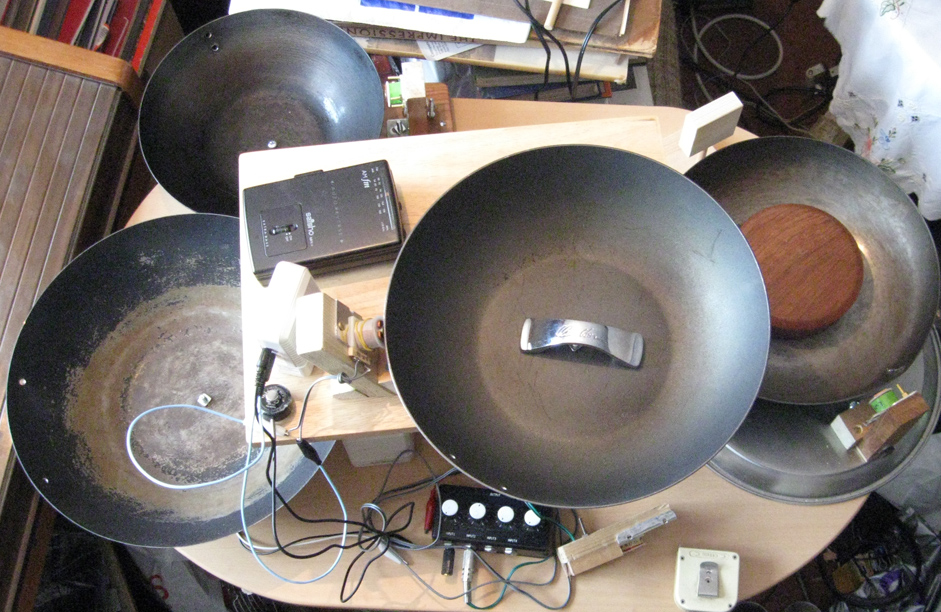
Wok Music: Music of the Hemispheres

The process of obtaining 'miraculous agitations', as I've written before, revolves around chance occurrences.  From a purely intuitive standpoint, it's hard to pin down the catalyst that transforms a vibrating apparatus from a 'bone-idle-tone' into inspirational 'tone-drama' (that is, the once-in-a-blue-moon complex and inspiring acoustic stuff).  It appears as a chance convergence of microscopic parameters: an imperceptible movement of some element suddenly causing an emergent state...

The standard stainless steel cooking bowls (un-wok-like), with a paucity of tone-ballast.
The cauldron is perhaps the paradigm of all this tone-drama-seeking malarkey.  In fact, it's surprising that cauldrons aren't used more often in improv gigs.  Objects may be placed in a vibrating cauldron and stirred until the much longed-for 'tone-drama' emerges.  The cauldron body would be resonated electromagnetically, and eventually, with enough stirring trials, there will arrive a point where a highly specific configuration is obtained, bringing about pulsing rhythms or harmonic progressions.

When I was angling to incorporate pseudo-cauldrons into resonant assemblies, the adage "beggars can't be choosers" manifested itself in the galling fact that dishes and bowls receptive to magnetism are very hard to find.  If you walk into a shop, all the stainless steel bowls will be non-magnetic.  This is frustrating, as many of the most resonant bowls will not be suitable for resonating via the electromagnetic field method (a non-contact method of resonating).

Looking in bins and trade waste containers can yield older steel bowls, where the steel was treated differently during manufacture, thus retaining its ferric virtue and allowing for EM resonation.  Although, these are rare.

Wok mounted to a sounding board with resonator and pickup coils.
Whereas in the past the poverty and unemployability that necessitated my dumpster-diving actions lent a teeth-gnashing restrictive atmosphere, it's now obvious that this impoverished flâneur approach embraces chance happenings: a good thing.  One day, a wok presented itself.  Woks can be easily adapted to resonate.  When a wok handle is removed, woks resound like Tibetan bowls...  And they're always (in my experience) responsive to magnetism too.  Woks are also somewhat hard to find, but they're easily spotted, at least, whether in bins, car-boot sales, or vistas of ruin.

When a resonator coil is fixed in proximity to a wok's rim, several harmonics can usually be obtained.  The most harmonically rich woks happen to be Ken Hom woks - this particular brand was the heaviest/densest I've so far found (the chrome handles of certain Ken Hom wok lids also make excellent subharmonic-generating objects to place inside woks).   The polarities and phase of the resonator coil / pickup coil combo can be arranged so that a descending scale of harmonics can be elicited by moving the pickup anticlockwise around the rim, on the right-hand side of the resonator (as shown in this scrawling).  When subharmonic ballast is added, a veritable sonic stir-fry is formed... with all the potency of the paradigmatic cauldron: thaumatacoustics in action.

So far, I have found four woks.  It is interesting to note that the resultant chords obtainable purely from the woks themselves - without adding objects inside - are chords of chance provided by the trade waste bins.   A convergence of people all deciding at a certain time to discard their woks resulted in this very specific chord.

I recorded a short and unpolished study simply to display aspects of this chord. (Please excuse the unskilful pickup collisions)....


Monday, 18 March 2013

Ivory Tower Misdoings, or "Something for Nothing"

The current acoustics-themed Leonardo Music Journal (#22) features my paper 'Miraculous Agitations: On the Uses of Chaotic, Non-Linear and Emergent Behaviour in Acoustic Vibrating Physical Systems'.  It gives an overview of the philosophy of miraculous agitations (or thaumatacoustics: acoustics compounded with the prefix 'thaumata', meaning 'wonder') and methods of electromagnetically resonating object-assemblies.  In the LMJ paper, I avoided describing how poverty shaped the philosophies behind miraculous agitation apparatuses.  I'll descant upon this aspect here.

An older composer - either misunderstanding my words or trying to 'get a rise' from me - once described the miraculous agitation technique as the "musical equivalent of benefit fraud"(!).   He believed that it was sheer laziness to sit and make arbitrary mechanical adjustments to piles of vibrating junk in the hope that a composition would compose itself.  I suppose he thought it was something like getting a "finished composition" for free.  Whilst his unusual angle was very thought-provoking, I'd have to summon to memory a quote that would be appreciated by someone of his generation: "I think you're entering the realms of fantasy here, Jones."

Music is traditionally composed - or 'worked out' - in 'horizontal' time (as most music sequencers scroll).  Thaumatacoustic apparatuses on the other hand are scrounged together, assembled and 'worked out' beforehand in an instance removed from time.  So the 'work' goes into the arrangement of global conditions outside time.  The composing here is principally a process of searching for objects, assembling objects and arranging an initial state in 'vertical' time, before the electromagnetic agitators are even switched on.  It's more about 'compositing' than 'composing'.  The actual tonestuff emerges over time, almost of its own accord, from largely unforeseen interactions within the assembly.
 
For an apparatus to be capable of producing sonically useful 'wonders', patience and perseverance is essential.  It is true that the apparatus is built from stuff pulled out dustbins - this is perhaps the part that the aforementioned critic took issue with.  This seems a contentious area (and it really shouldn't be).  To this day, passive-aggressive people still crow "should you be doing that?" and "go away" whilst I'm searching for acoustic parts in bins.

I'd be a great sound designer, researcher or archivist at the British Library's sound archive (for example), but frustratingly, employment has not been forthcoming.  I've ranted about this elsewhere...  Jobseeker's Allowance was cut off.  Poverty compelled me to rummage through bins, for food, entertainment, tools and raw materials for quasi-saleable crafted miscellany (including miraculous agitation assemblies).  It's scandalous to behold how much usefulness gets discarded.  The thaumatacoustic philosophy is ensconced in these experiences.

In the light of this seemingly beggarly state, it was invigorating to find on March 2nd that five messages had reached me through diverse channels.  The messages were all from one researcher for RDF Television / Zodiak Media, apparently involved in making a TV documentary for Channel 4:

Hi there,
I was wondering if you might be able to help me. I work for a TV production company called RDF Television and we are currently working on a new show for Channel 4 – which looks into all the weird and wonderful things you can get for free.

I have come across a sound artist called Dan Wilson who creates musical instruments out of unwanted goods and electrical parts he finds in skips and I read that he sometimes performs with Oscillatorial Binnage.

I would really like to have a chat with Dan but can’t find any contact details for him any where. I was wondering if you could let me know if there is any way of getting in touch with him or perhaps you could forward this email on to him so he can get in touch with me? Just want to have a chat with Dan about what he does.

You can contact me here or my email address is ----  or my direct number is -----.

Hope to hear from you,
---


These TV researchers often cast their net widely, and I did suspect that they might find me too weird a fish for their fishtank.  I described my practices and provided links to various examples, but also lamented that I couldn't produce more expository audio examples due to lack of equipment (more high quality microphones would be a Godsend).

The correspondent elaborated on their remit:

I’m not sure how much I explained about the show.  We’re making a consumer programme for channel 4, that looks into all the things you can get for free – weird and wonderful things that you might not think of.

I really liked the idea that you make instruments from electrical  items you find in skips and that is what I was interested in talking to you about. We’re looking for people who are experts in their field who would like to talk on camera about their experiences – for example the pitfalls of skip diving / the best places to go for the best finds – so we’re looking for a spokesperson who can tell us about the ‘art’ of skip diving. It’s not so much about the music itself, I’m afraid.

I’m not sure if this is something you would be interested in at all?


Yes - it sounded worthwhile and useful exposure.  But then came the bitter irony.  Any payment?  "There is no payment, I’m afraid, as we don’t have the budget."   So, a programme about the "weird and wonderful things you can get for free" is trying to source the raw materials for free!

This reminded me of a certain King's Cross publisher who, some years ago, sought to find homeless 'renegade gardeners' to write for them about their personal experiences of homeless gardening.  There was no payment for this work, yet the book would retail for +£15 per copy.

I gently berated the RDF correspondent: "Not wishing to sound exhortational - it seems a bit skew-whiff to make a programme about bin-diving - a last resort for the poorest and most vulnerable in society - and not pay the interviewees!"

The reply was defensive and ambiguous: "It is a factual documentary to show the general public that there are benefits to be had in this time of financial crisis. And in no way will we be showing ways in which to take from people who really need it."  ('Benefits to be had in this time of financial crisis'?!?)  One media behemoth I once dealt with some years ago had its minions bandying about the term "loser generated content" with some enthusiasm, and I've been wary of these sapping dilettantes ever since.

Nevertheless, I agreed to provide some insight for this programme, but suddenly the doors had closed tightly:  the reply read "I’m afraid the format of the show has slightly changed in the past couple of weeks. When I last spoke to you we were still in the early research stages and seeing what stories were out there, but now we have fully cast all our contributors and experts."

Disappointments far outnumber wonders when searching for miraculous agitations.  I sighed, and an apparatus set on a cardboard box sympathetically buzzed in an interesting manner.

Wednesday, 12 September 2012

The Wire issue 344: Unofficial Channels: 'Acoustic Synthesis' and Post-Electronic Sound

The 'Unofficial Channels' column of this month's Wire magazine (#344) hosts a very short piece I've written on Acoustic Synthesis, giving a short overview on experimental manoeuvrings in the largely undefined sphere of post-electronic music.

As described elsewhere, 'post-electronic music' is a term I use to refer to the application of classical electronic music technique to acoustic systems, usually involving electro-mechanical parts and mechanical gears.

The sub-harmonic demonstrations of music theorist José A. Sotorrio are mentioned in the column.  Sotorrio's introduction to the undertone series can be viewed here on Youtube.  A sounding tuning fork held against a movable obstruction (such as paper) produces different notes of the undertone series (seen at 1:00 in the video).  The ease at which the undertones can be elicited in physical vibrating systems provides glimpses of a sonic netherworld quite distinct from musical traditions derived from the overtone series.

Acoustic synthesis (as I practice it, at least) is principally concerned with enhancing the exactness with which mechanical controls act upon vibrating assemblies.  For instance, an electromagnetically sustained tuning fork may be gradually brought into contact with the paper by a vernier gear with a very high reduction ratio - this would allow undertones to be slowly scanned through discretely and selected.  These kinds of colliding interactions are an integral part of tone production.

The usage of adjustable prong-umbrellas to build up subharmonics (note the usage of a reverberant grille-pile)
The rich effect of subharmonics / undertones can be heard at the end of this short unfinished study on a small apparatus.   The growling occurs due to a vibrating prong colliding with a Rice Krispies box, periodically repelling it, before making contact again.  A swinging microphone adds a timbre shifting effect.


One may well wonder about the origins of post-electronic music.  I had often wondered if an 'acoustic equivalent' of a synthesiser was theorised during the electronic music heyday of the 1970s, or even earlier.  It seems that this was indeed almost touched upon by Terence Dwyer in his 1975 school course Making Electronic Music (Book 2 - Advanced).  The work of Terence Dwyer (now in his 90s) has received fresh attention recently thanks to Ian Helliwell's captivating article in last month's The Wire (#343).

It is interesting to find Terence Dwyer suggesting the acoustic mimicry of electronic sounds in a volume of his Making Electronic Music textbook.  The textbooks serve as an introduction to the rudiments of electronic music for school students, but are practically concerned with tape splicing and tape effects.  Curiously, Book 2 contains a small section titled 'Imitating Electronic Sounds' - wonderful wispings towards a post-electronic modus operandi!  Acoustic equivalents are given: electronic waveforms and their acoustic substitutes:

Sine wave (pure, no harmonics) - Recorder, Tuning Fork, Whistling, Rubbed Wine Glass

Sawtooth (ramp) wave (all harmonics) - Kazoo, Comb and Paper

Squarewave (odd numbered harmonics) - Clarinet

White noise (random superimposition of all frequencies) - Vocal hissing by several people

Filtered noise (narrow bands of random frequencies) - One person making various hissings such as Ss, Sh, Ch, F, V, Z, Zh, Kh, Hh