Tuesday, 16 July 2013

Bookophonics: Making Music with Books

The bookophone is described in an earlier post here.  It involves a paperback book and a bowing rod - preferably some kind of hollow tube, upon which the friction tone is amplified.  The character of the tone derives somewhat from the choice of bowing rod.

Playing bookophones
Last Friday, a short bookophone piece called 'Summer Song' was debuted on William English and Chris Weaver's Weavelength (part of a series of Wavelength specials touching on cassette culture).  All the sounds in this piece are created by four paperback books overdubbed together: 'Social Anthropology in Perspective,' Bird's 'Mathematical Formulae,' 'Great Mambo Chicken and the Transhuman Condition,' and 'Is it Just Me or is Everything Shit?'.   The books are played with plastic and chrome bows.

It appears that temperature affects the bookophone sound.   Bookophones are generally deeply unplayable things and near-impossible to wrest a melody from, despite weeks of practice.  In the summer season, books are apparently more stubborn than usual in producing tones, demanding a more vigorous action (as heard in this piece).  This is perhaps because there is less discrepancy between the environmental warm temperature and the momentary heat caused by the bow friction(?).  Dryness certainly deadens the tones.  Anyways, it just means that in the summer, when playing the bookophone, you must really 'give it some welly'.

I can't seem to find any similar technique employed in making books 'sing', but surely over 500 years somebody must've tried something similar.  Maybe a romantic poet?   Incidentally, the very clever Maywa Denki laboratory has produced a musical electric book beating apparatus.  (Maywa Denki received exposure in the UK some years ago with a memorable appearance of a self-playing acoustic guitar on BBC One's Adam and Joe Go Tokyo.)

Thursday, 4 July 2013

Wok Music: Music of the Hemispheres

The process of obtaining 'miraculous agitations', as I've written before, revolves around chance occurrences.  From a purely intuitive standpoint, it's hard to pin down the catalyst that transforms a vibrating apparatus from a 'bone-idle-tone' into inspirational 'tone-drama' (that is, the once-in-a-blue-moon complex and inspiring acoustic stuff).  It appears as a chance convergence of microscopic parameters: an imperceptible movement of some element suddenly causing an emergent state...

The standard stainless steel cooking bowls (un-wok-like), with a paucity of tone-ballast.
The cauldron is perhaps the paradigm of all this tone-drama-seeking malarkey.  In fact, it's surprising that cauldrons aren't used more often in improv gigs.  Objects may be placed in a vibrating cauldron and stirred until the much longed-for 'tone-drama' emerges.  The cauldron body would be resonated electromagnetically, and eventually, with enough stirring trials, there will arrive a point where a highly specific configuration is obtained, bringing about pulsing rhythms or harmonic progressions.

When I was angling to incorporate pseudo-cauldrons into resonant assemblies, the adage "beggars can't be choosers" manifested itself in the galling fact that dishes and bowls receptive to magnetism are very hard to find.  If you walk into a shop, all the stainless steel bowls will be non-magnetic.  This is frustrating, as many of the most resonant bowls will not be suitable for resonating via the electromagnetic field method (a non-contact method of resonating).

Looking in bins and trade waste containers can yield older steel bowls, where the steel was treated differently during manufacture, thus retaining its ferric virtue and allowing for EM resonation.  Although, these are rare.

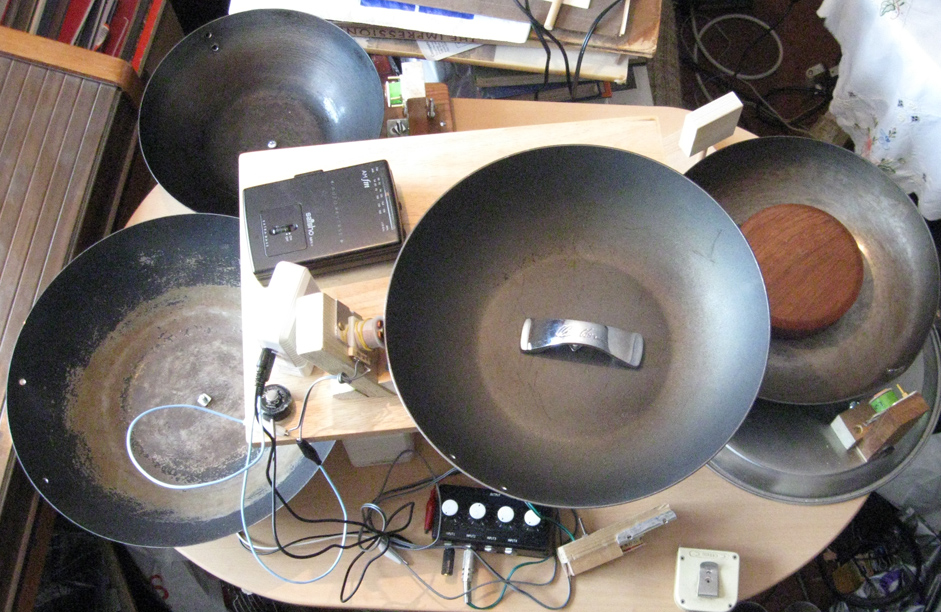
Wok mounted to a sounding board with resonator and pickup coils.
Whereas in the past the poverty and unemployability that necessitated my dumpster-diving actions lent a teeth-gnashing restrictive atmosphere, it's now obvious that this impoverished flâneur approach embraces chance happenings: a good thing.  One day, a wok presented itself.  Woks can be easily adapted to resonate.  When a wok handle is removed, woks resound like Tibetan bowls...  And they're always (in my experience) responsive to magnetism too.  Woks are also somewhat hard to find, but they're easily spotted, at least, whether in bins, car-boot sales, or vistas of ruin.

When a resonator coil is fixed in proximity to a wok's rim, several harmonics can usually be obtained.  The most harmonically rich woks happen to be Ken Hom woks - this particular brand was the heaviest/densest I've so far found (the chrome handles of certain Ken Hom wok lids also make excellent subharmonic-generating objects to place inside woks).   The polarities and phase of the resonator coil / pickup coil combo can be arranged so that a descending scale of harmonics can be elicited by moving the pickup anticlockwise around the rim, on the right-hand side of the resonator (as shown in this scrawling).  When subharmonic ballast is added, a veritable sonic stir-fry is formed... with all the potency of the paradigmatic cauldron: thaumatacoustics in action.

So far, I have found four woks.  It is interesting to note that the resultant chords obtainable purely from the woks themselves - without adding objects inside - are chords of chance provided by the trade waste bins.   A convergence of people all deciding at a certain time to discard their woks resulted in this very specific chord.

I recorded a short and unpolished study simply to display aspects of this chord. (Please excuse the unskilful pickup collisions)....


Monday, 25 March 2013

Build your own Francis Bacon 'Sound-House'

I feel behaviourally aslant in my secret indulgence for dolls house paraphernalia.  But that's mainly due to a culturally-instilled inhibition that really needs to be shaken off.  After all, dolls houses are affordable, but real houses are not.  As the saying goes, you must "live within your means".

'Rendering that scaffolding dangerous'
For some years now I've itched to create a Sound-House, as defined in Sir Francis Bacon's unfinished fable 'New Atlantis' (1624):

“We have also sound-houses, where we practise and demonstrate all sounds and their generation.  We have harmonies which you have not, of quarter-sounds, and lesser slides of sounds; divers instruments of musick likewise to you unknown, some sweeter than any you have, with bells and rings that are dainty and sweet.  We represent small sounds as great and deep, likewise great sounds extenuate and sharp.  We make divers tremblings and warblings of sounds, which in their original are entire.  We represent and imitate all articulate sounds and letters, and the voices and notes of beasts and birds.  We have certain helps, which set to the ear, do further the hearing greatly.  We have also divers strange and artificial echos reflecting the voice many times, and as it were tossing it, and some that give back the voice louder than it came, some shriller, and some deeper, yea, some rendring the voice differing in the letters or articulate sound from that they receive.  We have all means to convey sounds in trunks and pipes in strange lines and distances.”

A previous posting (here) touched upon some visual clues as to how Francis Bacon may have designed his Sound House if he had been tasked with realising one.

The "we have also sound-houses" passage has come to be quoted as a foresightful envisioning of electronic sound treatments.  Yet the majority of modern electronic works invariably pivot on trickeries and deceptions of the ear - keeping the listener 'in the dark' as to the nature of sound sources and treatments.  (Also, Bacon's words conjure to mind a mechanical acoustic endeavour with contrivances similar to those imagined by his inventor contemporaries Salomon de Caus or Cornelis Drebbel.)  Allying Bacon's Sound Houses with electronic sound technique seems incongruous when Bacon later writes a few paragraphs later:

“And surely, you will easily believe that we that have so many things truly natural, which induce admiration, could in a world of particulars deceive the senses, if we would disguise those things, and labour to make them more miraculous: But we do hate all impostures and lies insomuch, as we have severely forbidden it to all our fellows, under pain of ignominy and fines, that they do not shew any natural work or thing adorned or swelling, but only pure as it is, and without all affectations of strangeness.”

John Reid: Pyramid Sound-Houses?
If I ever had the opportunity to build a full size Baconian sound house, it would contain resonant granite sarcophagi (akin to those found in Egyptian tombs), moveable granite panelling and compartments.   Deep stone tunnels with mix-and-match obstructors.  Parallel surfaces for flutter echoes.  Bellow-pumped pipe tone generators and trumpeted alterants.   Clues may also be found in Bacon's acoustical investigations documented in his Sylva Sylvarum.  In the meantime, I will continue experimenting with my dolls houses...  The dolls houses are more like weird garages, over-plumbed within an inch of their daintiness.  And the 'dolls' exist only in the mind.

Miraculous agitations in our acoustic environment - as I've written elsewhere - indicate the possibility of real-world sound rivalling electronic sound in terms of tonal complexity and delineation.  It is a question of engineering.  The miraculous agitation assemblies eventually come to resemble 'houses' - or 'garages' - stressed with the addition of perilously piled Jenga-like miscellany.  An 'electromechnical Baconian dolls soundhouse garage'.   With all property so dismally unaffordable,  I would like to live in one of these... cohabiting with Cliff Richard's proverbial 'Living Doll' - a husk of hope. ("Take a look at her hair, it's real / And if you don't believe what I say, just feel / I'm gonna lock her up in a trunk / So no big hunk can steal her away from me" [?!])

Monday, 18 March 2013

Ivory Tower Misdoings, or "Something for Nothing"

The current acoustics-themed Leonardo Music Journal (#22) features my paper 'Miraculous Agitations: On the Uses of Chaotic, Non-Linear and Emergent Behaviour in Acoustic Vibrating Physical Systems'.  It gives an overview of the philosophy of miraculous agitations (or thaumatacoustics: acoustics compounded with the prefix 'thaumata', meaning 'wonder') and methods of electromagnetically resonating object-assemblies.  In the LMJ paper, I avoided describing how poverty shaped the philosophies behind miraculous agitation apparatuses.  I'll descant upon this aspect here.

An older composer - either misunderstanding my words or trying to 'get a rise' from me - once described the miraculous agitation technique as the "musical equivalent of benefit fraud"(!).   He believed that it was sheer laziness to sit and make arbitrary mechanical adjustments to piles of vibrating junk in the hope that a composition would compose itself.  I suppose he thought it was something like getting a "finished composition" for free.  Whilst his unusual angle was very thought-provoking, I'd have to summon to memory a quote that would be appreciated by someone of his generation: "I think you're entering the realms of fantasy here, Jones."

Music is traditionally composed - or 'worked out' - in 'horizontal' time (as most music sequencers scroll).  Thaumatacoustic apparatuses on the other hand are scrounged together, assembled and 'worked out' beforehand in an instance removed from time.  So the 'work' goes into the arrangement of global conditions outside time.  The composing here is principally a process of searching for objects, assembling objects and arranging an initial state in 'vertical' time, before the electromagnetic agitators are even switched on.  It's more about 'compositing' than 'composing'.  The actual tonestuff emerges over time, almost of its own accord, from largely unforeseen interactions within the assembly.
 
For an apparatus to be capable of producing sonically useful 'wonders', patience and perseverance is essential.  It is true that the apparatus is built from stuff pulled out dustbins - this is perhaps the part that the aforementioned critic took issue with.  This seems a contentious area (and it really shouldn't be).  To this day, passive-aggressive people still crow "should you be doing that?" and "go away" whilst I'm searching for acoustic parts in bins.

I'd be a great sound designer, researcher or archivist at the British Library's sound archive (for example), but frustratingly, employment has not been forthcoming.  I've ranted about this elsewhere...  Jobseeker's Allowance was cut off.  Poverty compelled me to rummage through bins, for food, entertainment, tools and raw materials for quasi-saleable crafted miscellany (including miraculous agitation assemblies).  It's scandalous to behold how much usefulness gets discarded.  The thaumatacoustic philosophy is ensconced in these experiences.

In the light of this seemingly beggarly state, it was invigorating to find on March 2nd that five messages had reached me through diverse channels.  The messages were all from one researcher for RDF Television / Zodiak Media, apparently involved in making a TV documentary for Channel 4:

Hi there,
I was wondering if you might be able to help me. I work for a TV production company called RDF Television and we are currently working on a new show for Channel 4 – which looks into all the weird and wonderful things you can get for free.

I have come across a sound artist called Dan Wilson who creates musical instruments out of unwanted goods and electrical parts he finds in skips and I read that he sometimes performs with Oscillatorial Binnage.

I would really like to have a chat with Dan but can’t find any contact details for him any where. I was wondering if you could let me know if there is any way of getting in touch with him or perhaps you could forward this email on to him so he can get in touch with me? Just want to have a chat with Dan about what he does.

You can contact me here or my email address is ----  or my direct number is -----.

Hope to hear from you,
---


These TV researchers often cast their net widely, and I did suspect that they might find me too weird a fish for their fishtank.  I described my practices and provided links to various examples, but also lamented that I couldn't produce more expository audio examples due to lack of equipment (more high quality microphones would be a Godsend).

The correspondent elaborated on their remit:

I’m not sure how much I explained about the show.  We’re making a consumer programme for channel 4, that looks into all the things you can get for free – weird and wonderful things that you might not think of.

I really liked the idea that you make instruments from electrical  items you find in skips and that is what I was interested in talking to you about. We’re looking for people who are experts in their field who would like to talk on camera about their experiences – for example the pitfalls of skip diving / the best places to go for the best finds – so we’re looking for a spokesperson who can tell us about the ‘art’ of skip diving. It’s not so much about the music itself, I’m afraid.

I’m not sure if this is something you would be interested in at all?


Yes - it sounded worthwhile and useful exposure.  But then came the bitter irony.  Any payment?  "There is no payment, I’m afraid, as we don’t have the budget."   So, a programme about the "weird and wonderful things you can get for free" is trying to source the raw materials for free!

This reminded me of a certain King's Cross publisher who, some years ago, sought to find homeless 'renegade gardeners' to write for them about their personal experiences of homeless gardening.  There was no payment for this work, yet the book would retail for +£15 per copy.

I gently berated the RDF correspondent: "Not wishing to sound exhortational - it seems a bit skew-whiff to make a programme about bin-diving - a last resort for the poorest and most vulnerable in society - and not pay the interviewees!"

The reply was defensive and ambiguous: "It is a factual documentary to show the general public that there are benefits to be had in this time of financial crisis. And in no way will we be showing ways in which to take from people who really need it."  ('Benefits to be had in this time of financial crisis'?!?)  One media behemoth I once dealt with some years ago had its minions bandying about the term "loser generated content" with some enthusiasm, and I've been wary of these sapping dilettantes ever since.

Nevertheless, I agreed to provide some insight for this programme, but suddenly the doors had closed tightly:  the reply read "I’m afraid the format of the show has slightly changed in the past couple of weeks. When I last spoke to you we were still in the early research stages and seeing what stories were out there, but now we have fully cast all our contributors and experts."

Disappointments far outnumber wonders when searching for miraculous agitations.  I sighed, and an apparatus set on a cardboard box sympathetically buzzed in an interesting manner.

Wednesday, 12 September 2012

The Wire issue 344: Unofficial Channels: 'Acoustic Synthesis' and Post-Electronic Sound

The 'Unofficial Channels' column of this month's Wire magazine (#344) hosts a very short piece I've written on Acoustic Synthesis, giving a short overview on experimental manoeuvrings in the largely undefined sphere of post-electronic music.

As described elsewhere, 'post-electronic music' is a term I use to refer to the application of classical electronic music technique to acoustic systems, usually involving electro-mechanical parts and mechanical gears.

The sub-harmonic demonstrations of music theorist José A. Sotorrio are mentioned in the column.  Sotorrio's introduction to the undertone series can be viewed here on Youtube.  A sounding tuning fork held against a movable obstruction (such as paper) produces different notes of the undertone series (seen at 1:00 in the video).  The ease at which the undertones can be elicited in physical vibrating systems provides glimpses of a sonic netherworld quite distinct from musical traditions derived from the overtone series.

Acoustic synthesis (as I practice it, at least) is principally concerned with enhancing the exactness with which mechanical controls act upon vibrating assemblies.  For instance, an electromagnetically sustained tuning fork may be gradually brought into contact with the paper by a vernier gear with a very high reduction ratio - this would allow undertones to be slowly scanned through discretely and selected.  These kinds of colliding interactions are an integral part of tone production.

The usage of adjustable prong-umbrellas to build up subharmonics (note the usage of a reverberant grille-pile)
The rich effect of subharmonics / undertones can be heard at the end of this short unfinished study on a small apparatus.   The growling occurs due to a vibrating prong colliding with a Rice Krispies box, periodically repelling it, before making contact again.  A swinging microphone adds a timbre shifting effect.


One may well wonder about the origins of post-electronic music.  I had often wondered if an 'acoustic equivalent' of a synthesiser was theorised during the electronic music heyday of the 1970s, or even earlier.  It seems that this was indeed almost touched upon by Terence Dwyer in his 1975 school course Making Electronic Music (Book 2 - Advanced).  The work of Terence Dwyer (now in his 90s) has received fresh attention recently thanks to Ian Helliwell's captivating article in last month's The Wire (#343).

It is interesting to find Terence Dwyer suggesting the acoustic mimicry of electronic sounds in a volume of his Making Electronic Music textbook.  The textbooks serve as an introduction to the rudiments of electronic music for school students, but are practically concerned with tape splicing and tape effects.  Curiously, Book 2 contains a small section titled 'Imitating Electronic Sounds' - wonderful wispings towards a post-electronic modus operandi!  Acoustic equivalents are given: electronic waveforms and their acoustic substitutes:

Sine wave (pure, no harmonics) - Recorder, Tuning Fork, Whistling, Rubbed Wine Glass

Sawtooth (ramp) wave (all harmonics) - Kazoo, Comb and Paper

Squarewave (odd numbered harmonics) - Clarinet

White noise (random superimposition of all frequencies) - Vocal hissing by several people

Filtered noise (narrow bands of random frequencies) - One person making various hissings such as Ss, Sh, Ch, F, V, Z, Zh, Kh, Hh

Tuesday, 24 July 2012

Nasca Octavian Paul's Paulstretch

Oscillatorial Binnage play room tones
I've recently been editing a 2010 Oscillatorial Binnage performance of a piece titled 'Variations for Rooms and a Tone'.  It features multiple strands of acoustic microphone feedback steered by injections of carefully pitched oscillator tones, and destabilised by various other subtle treatments.  The pitch of the feedback relates to the resonant frequency of the space(s).  Conceptually, it may not sound entirely original (it certainly owes some debt to Alvin Lucier who explored this terrain), but its originality lies principally in the choice of venue - every space having its own unique cluster of tones: a 'sonic fingerprint'.  This particular 2010 recording was performed at a soon-to-be-demolished former bus depot in Neckinger, known as the Woodmill.  It has unusual resonant cubbyholes allowing for many shifts of resonance.

The editing has been slow owing to an obligation to 'do justice' to the old space.  Further complications involve the removal of countless footsteps, which would have to be removed via individual crossfades.

The most fascinating microphone/speaker feedback tones occur when the feedback has not yet stabilised, i.e. when the feedback tone is still 'finding itself' after the soundsystem is turned on.  Transitions between conflicted resonances are also very musical.  Yet these moments do not last long, and a way to cleanly extend these moments without affecting quality and pitch is sought.

One notable program comes to the rescue in such situations - a wonderful high-powered timestretcher by Nasca Octavian Paul.  It is called PaulStretch, and most people may have already stumbled upon its fruits in the "800% slower" music stretches on Youtube.  Those who aren't yet acquainted with it are in for a treat - it allows for lusciously smooth timestretching (along with other treatments) and is specifically designed for long-duration stretches.  PaulStretch can extend a 15-second sound to one lasting over 475 billion years.


It has been used extensively on many unlikely sonics, such as Rick Astley and Justin Bieber hits, the late ‪Eduard Khil‬'s lyricless epic 'Я очень рад, ведь я, наконец, возвращаюсь домой' (aka Trololo), the Eastenders theme, and my own favourite, Jerry Goldsmith's theme to the 1990 film Total Recall.  What initially seem like exercises in trollsome ridiculousness play out as astonishing ethereal meditations.  The beauty of Paulstretch is in its sophisticated algorithm where percussion and drum noise - which would usually become discordant metallic barking in bog-standard timestretchers - are rendered as luscious crashing waves, in keeping with a percussive nature.

It is a curious experience to play old chiptunes, MOD music and Amiga game themes through Paulstretch.  8-bit tones retain their familiarity, yet become uncharacteristically epic in proportion.   Other interesting experiences may be had by playing pure intonation music in Paulstretch.  For example, some of the more complex moments of La Monte Young's 'Well Tuned Piano' - which itself is a long-duration piece of over six hours - become even more fascinating.  Some of the beat-frequency forming 'cloud' effects such as those heard on CD 4 of the 1992 Gramavision release benefit from Paulstretch treatment.  I won't post any examples here, but the software is free and there seems to be a world of potential.  One commentator asks "could this be the start of a new age of music?"   It certainly offers a new viewpoint which can be at times awing to the point of unnerving.

Such clean timestretching is extremely useful for elongating hyperinteresting short sounds, such as the elusive miraculous agitations, and various bookophone flourishes.

Nasca Octavian Paul has also programmed such excellences as the ZynAddSubFX soft-synth and the HyperMammut Fourier transform tool among other things...

Sunday, 10 June 2012

Bookophone Outing

I comprise one quarter of the improv quartet Oscillatorial Binnage.  Last Thursday we played a short set at the AMM book launch.  Due to an alleged paucity of electricity sockets at the venue, it seemed an appropriate occasion to test drive an acoustic oddity I devised which I call a bookophone.

A bookophone consists of a paperback book and a rod/pipe 'activator bow' of some description.  The rod can be metal, plastic or lacquered wood, and it is drawn perpendicularly across the book's textblock in a bowing action.  It produces acoustic pseudo-shepard tones and, with some practice, a variety of barks and yelps can be produced.

Bookophone technique: A metal 'activator bow' is rubbed across the book

The AMM event was one of the more off-the-wall performances of recent memory.  The two new books being discussed that night were Ben Watson's Blake in Cambridge, and 1839: The Chartist Insurrection by David Black and Chris Ford, both books published by Unkant.   (Tangentially, whilst setting up the space, Ben Watson found convenience in my bookophone's 'activator bow' in liberating from the ceiling the Union Jack bunting left over from a Queen's Jubilee celebration some days earlier).

Interestingly, Watson chose to launch his own book by giving a platform to its critics who proceeded to denounce various aspects of its content, creating much debate (which also encompassed ventings on AMM's anti-academic stance).   Watson - an expert in language-defying tone poetry and mega-freeform vocalistics - then encouraged Oscillatorial Binnage to acoustically ornament/mimic the ensuing debate, which was already agitated by Watson's occasional divergences into his hyperconfusing wordjazz.  Electronics, crackleboxes, bean slicer, clarinet, squeaky toilet paper holder combo, harmonica and bookophone (among other things - mostly stuff found in bins) culminated in a noisome uproar.  Regretfully, some of the younger people present did not at all enjoy the ultra-high pitched amplified blasts.  (All recordings can be heard here).


To change the subject slightly.... My shoes are always broken.  Earlier that rainy, rainy day, I had been in the second-hand book basement of a King's Cross bookshop, trying to identify a louder £1 book for bookophone implementation (without actually compromising the shop's stock by bowing the book edges).  Owing to a hole in my shoe, rainwater had made ingress to my sock, making an unpleasantly wet foot; an irritating feeling which distracted me and so impaired bookophonic sonic book judgement.  Abandoning the search, inspiration made me hop to the British Library where strong plastic bags can be obtained - most convenient!   There, I made myself a plastic sock to place inside my shoe thereby offering protection against the rainwater.  This provided comfort, not just for the rest of the day, but for the next week too.


[Such a feet/feat of necessity is perhaps worthy of Vladimir Arkhipov's attention: specifically his Home Made series of books cataloging folk artefacts borne of such necessity].

However, by the time the AMM book launch began, the plastic sock had started to smell really bad.  There's an esoteric quirk of hygiene that sees unventilated feet turn odorous.  Yet by the unpremeditated combining of the bookophone sounds with the 'British Library bag-sock' footsmell generator, I had fused both scent and sound into a new emission-sensation.  However, the other members of Oscillatorial Binnage were undecided and mildly dismissive of it.  I did wonder what the academics and anti-academics would make of this multi-faceted concept-fusion of bookophonics, British Library bag-socks, bad odour twinned with questionable bookwhine sonics...  It is probably too irrelevant or 'lumpenproletarianesque' to even contemplate.